Small businesses in the UK can access grants and funding to reduce the financial burden of leadership training. These programmes include the Help to Grow: Management scheme, offering 90% subsidised training for senior managers, and apprenticeship funding, which will fully cover training costs for under-25s from 2026. Regional initiatives, such as Made Smarter, provide additional support for sectors like manufacturing, with grants often tied to leadership and digital skills development.
Costs for leadership programmes vary, with options like the Help to Grow course priced at £750 per participant after subsidies. Regional grants may also cover tailored training, mentoring, or consultancy. Eligibility typically depends on business size, location, and sector, with application processes requiring clear plans to show training outcomes.
This guide explains national and regional funding options, eligibility criteria, and how to combine grants with private providers. Visit GOV.UK or Leadership Training Hub to compare providers and start planning your leadership development strategy.
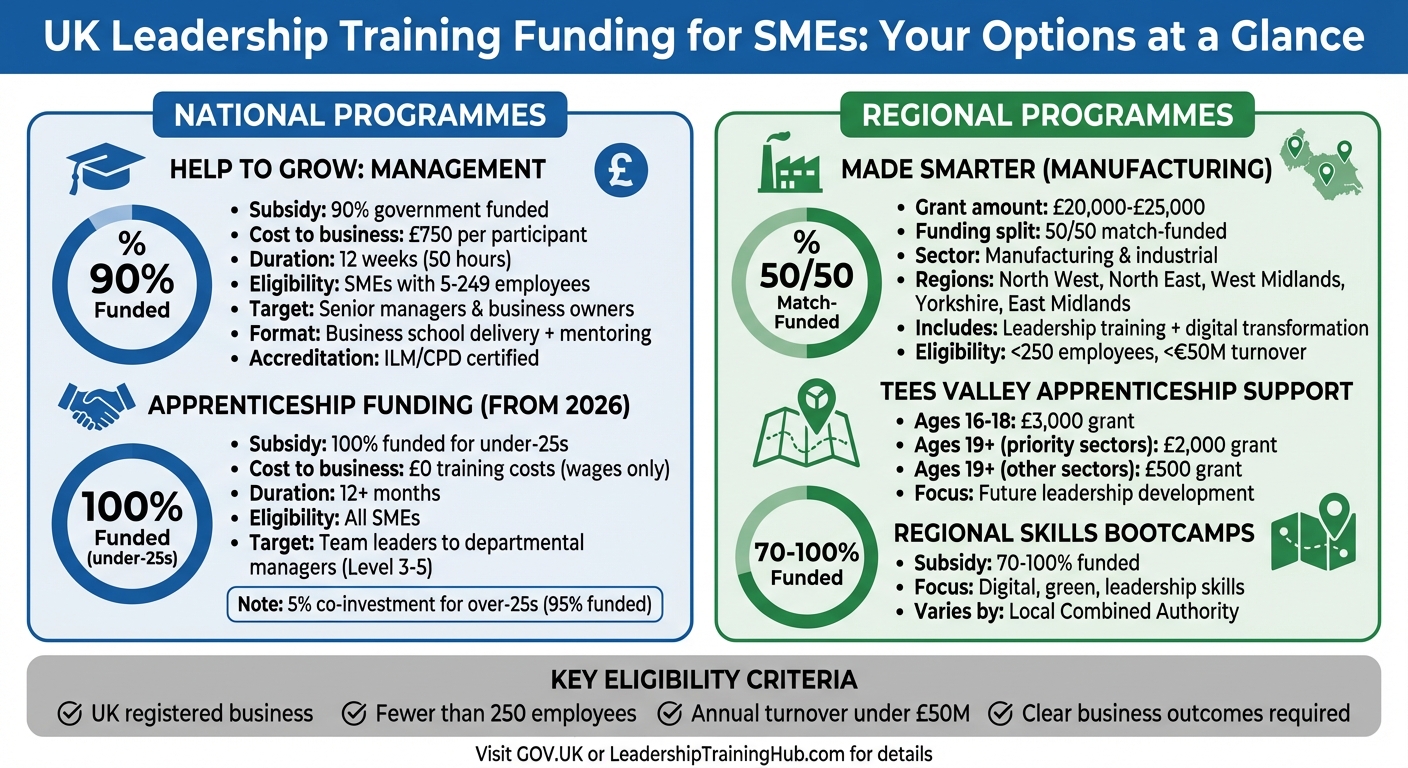
UK Leadership Training Funding Options for SMEs: National and Regional Grants Comparison
National Funding Programmes for Leadership Training
Two government initiatives are available to help SMEs reduce the upfront costs of leadership training. These schemes vary in their structure, duration, and the roles they target, allowing businesses to choose the most suitable option based on their size and immediate needs. Below is an overview of each programme, including how they work and the benefits they offer.
Help to Grow: Management Programme
This programme offers 50 hours of leadership and management training over a period of 12 weeks, delivered by UK business schools. It is specifically designed for senior managers and business owners in SMEs with 5 to 249 employees. The government subsidises 90% of the cost, meaning businesses only pay around £750, which is significantly less than comparable commercial training.
The course combines one-to-one mentoring with peer-to-peer learning, providing participants with practical tools to develop growth strategies alongside a structured curriculum. Training providers such as Lighthouse Group and MTD Training deliver this programme, often with ILM or CPD accreditation. To apply, visit the GOV.UK "Business and Self-Employed" portal, where you can check eligibility and confirm subsidy details.
Apprenticeship Training Funding for Under-25s
From 2026, the government will cover 100% of apprenticeship training costs for employees under 25, removing the previous 5% co-investment requirement. This funding applies to leadership and management apprenticeship standards, including roles like Level 3 Team Leader/Supervisor and Level 5 Operations/Departmental Manager.
Training, which lasts 12 months or more, is delivered by accredited providers listed on the Register of Apprenticeship Training Providers (RoATP), such as Lighthouse Group and MTD Training. While employers are still responsible for paying apprentices’ wages and ensuring they have adequate off-the-job training time, the training and assessment costs are fully funded. For employees aged over 25, SMEs contribute 5% of the training costs, with the government covering the remaining 95%. This option is ideal for businesses looking to build leadership skills through vocational development pathways.
Regional and Sector-Specific Funding Options
In addition to national funding opportunities, regional schemes provide focused support tailored to local priorities, often aligning with leadership development and broader business goals. These initiatives frequently combine leadership training with other business support measures, with eligibility and benefits varying by region and sector.
Made Smarter Leadership and Skills Grants

The Made Smarter programme is a regional initiative aimed at helping manufacturing and industrial SMEs adopt Industry 4.0 technologies while enhancing leadership within senior teams. Initially piloted in the North West, it has since expanded to regions like the North East, West Midlands, Yorkshire & Humber, and East Midlands. Although delivery models differ slightly across these areas, the core objectives remain consistent: strengthening leadership and promoting digital transformation.
The programme typically offers fully funded or heavily subsidised leadership and digital skills training for business owners and senior managers. This is often paired with match-funded grants for projects focused on innovation and technology adoption. SMEs can usually access grant contributions of £20,000 to £25,000 on a 50/50 funding basis. Eligible costs include training fees, consultancy services, and internal staff time directly related to the project. To qualify, businesses must be UK-registered SMEs with fewer than 250 employees and a turnover below the EU-SME threshold (approximately €50 million). They should operate in manufacturing, engineering, or other recognised industrial sectors and demonstrate how leadership development will lead to measurable outcomes such as improved productivity, new product development, export growth, or reduced carbon emissions.
Other local schemes also cater to specific sectors, offering targeted leadership training grants.
Regional Grant Examples
Several combined authorities and local enterprise partnerships (LEPs) provide grants to offset leadership training costs, often focusing on priority industries or workforce development goals. For instance, the Tees Valley Apprenticeship Support Grant offers £3,000 for apprentices aged 16–18 in priority sectors, £2,000 for those aged 19+, and £500 for apprentices aged 19+ outside these sectors. This funding supports leadership development through structured apprenticeship programmes.
Other regions provide assistance through growth hubs, skills bootcamps, and sector-specific funds. These programmes often include leadership and management training as eligible costs within broader initiatives, such as innovation or export projects. Grant amounts can vary, ranging from a few hundred pounds for minor training subsidies to several thousand pounds for apprenticeships or leadership programmes. Eligibility typically depends on company size, sector alignment, regional presence, and the potential for economic impact.
| Scheme / Region | Sector Focus | Typical Grant Amount | Leadership Element | Key Eligibility Points |
|---|---|---|---|---|
| Made Smarter (regional variants) | Manufacturing & industrial digital | £20,000–£25,000 match-funded | Leadership training and mentoring | SME manufacturers in participating regions; digital focus |
| Tees Valley Apprenticeship Support | Cross-sector with priority sectors | £3,000 (16–18); £2,000 (19+ priority); £500 (19+ non-priority) | Supports future leaders via apprenticeships | SMEs in Tees Valley employing eligible apprentices |
| Generic regional skills / bootcamps | Digital, green, leadership | 70–100% funded training places | Courses on leadership, management, and digital skills | Regionally located SMEs; size and thematic alignment |
SMEs are encouraged to visit their local Combined Authority or Growth Hub websites for up-to-date information on available schemes, as many operate on time-limited funding rounds with evolving criteria. Manufacturing businesses, in particular, may benefit from exploring Made Smarter’s leadership and management programmes alongside its technology adoption grants, enabling them to integrate leadership development with digital investment.
These regional funding options serve as a complement to the national programmes highlighted earlier.
How to Check Eligibility and Apply
To qualify for SME grants, your business typically needs to be registered in the UK, employ fewer than 250 people, and have an annual turnover of under £50 million. Additionally, the training you seek funding for must aim to achieve specific business outcomes. Some grant schemes may also have sector-specific or regional requirements, so it’s crucial to confirm your business meets the size, sector, and location criteria for the programme you're considering.
The GOV.UK website is a key resource for verifying eligibility and accessing application portals. Begin in the "Business and self-employed" section, where the "Finance and support for your business" tool allows you to filter grants by location, business size, and industry. For funding related to apprenticeship-based leadership training, explore the "Education and learning" section. Detailed eligibility requirements for specific schemes, such as Help to Grow or Made Smarter, are available under the "Guidance and regulation" section. Once you've confirmed eligibility, you can move on to preparing your application.
When crafting your application, focus on presenting a clear and measurable case for the training’s expected outcomes. Most grant applications require a well-structured plan that demonstrates how the training will deliver tangible results such as increased productivity or revenue growth. Partnering with accredited providers, like those recognised by ILM or CPD, can add weight to your application. Many businesses opt to evaluate two or three providers to show they’ve conducted thorough research and are committed to getting value for money.
Customise each application to align with the specific priorities of the grant scheme, highlighting how the leadership training will address your business’s needs. Ensure your HMRC and tax accounts are set up on GOV.UK beforehand, as these are often necessary for managing funding applications.
Finally, keep checking GOV.UK for any updates on grant eligibility criteria and application deadlines.
sbb-itb-fa39ac2
Using Grants with Leadership Training Providers
Once you've confirmed eligibility and prepared your grant application, the next step is to choose a provider whose pricing and invoicing align with the grant's conditions. Share the grant's requirements with your shortlisted providers and request written confirmation that they can meet these terms. For instance, they may need to separate training fees from non-eligible costs like travel or accommodation or provide attendance records and learning outcomes for reimbursement purposes. Taking this step early ensures everything is set up for smooth administrative compliance.
Focus on providers who have experience with grant-funded or government-backed programmes. These providers are typically well-versed in the reporting and compliance processes, which can significantly reduce your administrative workload.
The Leadership Training Hub (https://leadershiptraininghub.com) is a valuable resource for meeting grant requirements. It helps SMEs compare UK-based providers by criteria such as specialism - whether that’s leadership development, change management, or team performance - delivery format (online, in-person, hybrid), and experience with grant-funded programmes. Some providers can also assist with levy transfers or confirm eligibility for fully funded under-25 apprenticeships starting in 2026. Most organisations shortlist two or three providers to ensure they’ve conducted thorough research and secured the best value for money.
When you’ve selected a provider, secure a contract that clearly outlines payment terms, fee breakdowns, and documentation requirements. Many grants reimburse costs after training has been completed or cover only a portion of the expenses. For instance, the Help to Grow scheme covers 90% of costs, leaving SMEs to pay the remaining 10% plus VAT and any indirect costs. Make sure invoicing schedules align with grant claim deadlines, and confirm who is responsible for providing necessary documentation, such as certificates, feedback summaries, or learning outcomes. With the contract in place, you can then focus on aligning the training with your business goals.
The training should deliver measurable results for your business. Discuss objectives such as boosting productivity, preparing for succession, or driving digital transformation when selecting a provider. You can also request tailored elements, like case studies or project work relevant to your industry or specific business challenges, provided these fit within the grant’s guidelines. Agree in advance on how success will be evaluated - whether through new processes implemented, changes in turnover, or improved staff engagement scores - so the training provides real value beyond simply meeting compliance requirements.
Conclusion
UK grants and funding programmes offer SMEs a way to develop leadership skills at a significantly reduced cost. National initiatives such as Help to Grow: Management provide substantial support, with a 90% government subsidy lowering the cost to about £750 per participant for a 12-week programme. This programme combines practical learning with a mix of online and in-person sessions. Independent evaluations highlight its impact, with 91% of participants reporting improved leadership skills and 74% noting better business resilience. From 2026, apprenticeships for under-25s will also be fully government-funded, removing the 5% employer contribution and making leadership development more accessible for younger managers.
Regional and sector-specific funding complements these national schemes, often tying leadership training to broader initiatives like business growth, digital transformation, or innovation. Programmes such as Made Smarter and the Tees Valley Apprenticeship Support Grants allow SMEs to align leadership development with local needs and sector challenges. With such a variety of funding options available, most SMEs can find a programme suited to their size, location, and specific goals.
Determining eligibility and finding the right provider is straightforward. GOV.UK and regional websites clearly outline criteria, and programmes like Help to Grow are designed to accommodate the schedules of SME leaders with flexible formats, including online sessions, workshops, and mentoring. Once funding is secured, you can visit Leadership Training Hub (https://leadershiptraininghub.com) to compare UK-based providers by their expertise and select the best partner to deliver tailored training alongside grant support. Shortlisting two or three providers ensures you maximise value.
To make the most of these opportunities, start by identifying one or two national programmes that suit your business size and leadership priorities. Then, explore regional or sector-specific grants relevant to your industry and location. Define clear objectives, such as improving strategic planning, managing teams, or navigating organisational change, to guide your funding choices. With a clear plan and funding options in place, use resources like Leadership Training Hub to compare providers and schedule your training over the next 6–12 months, turning funding support into measurable improvements for your business.
FAQs
How can small businesses apply for the Help to Grow: Management programme?
Small businesses interested in the Help to Grow: Management programme can register through the UK government’s official website or via approved delivery partners. This initiative offers subsidised leadership and management training aimed at equipping eligible SMEs with the skills needed to support growth.
To be eligible, businesses must meet certain criteria, including being UK-based and having between 5 and 249 employees. For more detailed information on how to apply, you can contact local business support organisations or refer to the programme’s official resources.
What do I need to qualify for regional grants for leadership training in the UK?
To access regional leadership training grants in the UK, your business generally needs to qualify as a small or medium-sized enterprise (SME) and operate within the specified region. Most grant schemes also require evidence of a clear need for leadership development, with plans that align with the region’s priorities or focus industries.
You may also need to prove your business’s financial stability and show a commitment to effectively applying the training. Since eligibility criteria can differ between funding programmes, it’s important to carefully review the specific requirements of each grant or seek advice from reliable sources.
How can I choose the best leadership training provider for a grant-funded programme?
When choosing a leadership training provider for a grant-funded programme, it’s essential to ensure they meet both your organisation’s objectives and the grant’s criteria. Focus on providers with relevant expertise, recognised accreditations, and a proven history of successfully managing similar funded initiatives.
Review the programme’s content, delivery method (whether in-person or online), and costs to confirm they align with your goals and budget. Additionally, client feedback can offer valuable insights into the provider’s reliability and effectiveness. These steps will help you select a provider that fits your needs with confidence.