Leadership training costs in the UK vary significantly based on the seniority of participants. Programmes for first-time managers typically range from £1,200 to £2,400 per person, mid-level training costs between £2,400 and £4,800, and executive-level options generally exceed £8,000. Costs increase with seniority due to the tailored nature of higher-level training, which often includes one-to-one coaching and bespoke content.
Delivery formats include in-person, online, and hybrid options, with durations ranging from short workshops to multi-month programmes. Organisations are advised to allocate 5% to 10% of a leader’s annual salary for development, as training can deliver a return of £2.86 for every £1 spent.
This article breaks down costs, formats, and ROI by leadership level, helping you compare options and shortlist providers. Explore our directory for detailed listings and pricing.
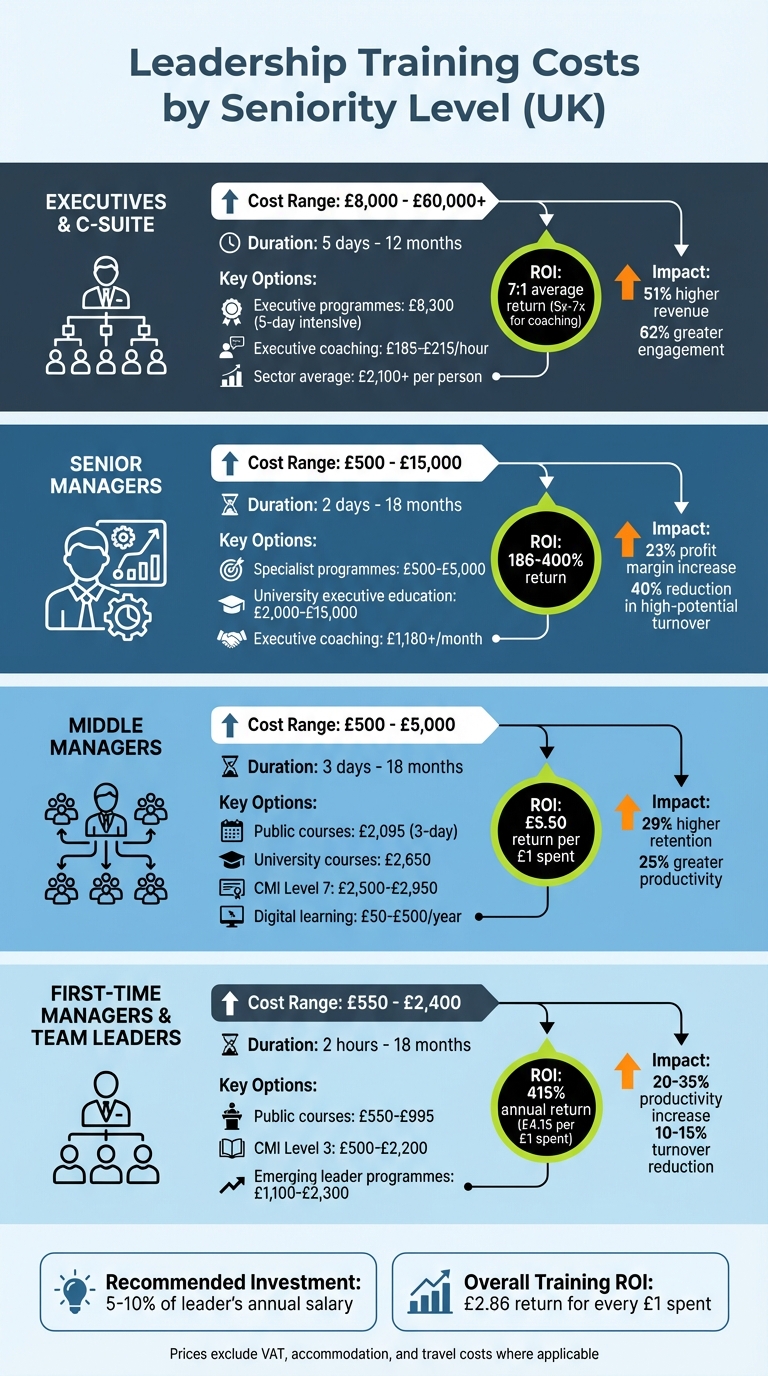
UK Leadership Training Costs by Seniority Level: Price Ranges and ROI Comparison
1. First-Time Managers and Team Leaders
Cost Range (GBP)
The cost of training for first-time managers varies widely depending on the type of programme. Open public courses, typically lasting one to two days, are priced between £550 and £995 + VAT per person. For those pursuing CMI Level 3 qualifications, certificates cost between £500 and £1,050, while diplomas range from £1,000 to £2,200. Emerging leader programmes, which often combine workshops with one-to-one coaching over several months, are priced between £1,100 and £2,300. For organisations with tighter budgets, shorter modules or grant-supported courses are available at £140 to £240 per session through specific funding schemes. These price variations reflect the diversity of training options available.
Delivery Format
Training providers typically offer hybrid formats, combining in-person workshops with remote sessions. This setup allows for greater flexibility and helps reduce travel costs. For more tailored support, some organisations provide two-hour remote one-to-one skills sessions, addressing specific challenges such as delegation or managing performance conversations. Short-form "micro-learning" modules are another option, designed for managers unable to commit to longer programmes. Additionally, government-backed apprenticeships offer a cost-effective solution for small businesses, with 95% of costs covered for eligible employers. The chosen delivery method often influences the overall duration of the training.
Duration
The duration of training programmes for first-time managers varies significantly. Options range from two-hour remote "power sessions", which focus on a single skill, to more extensive 12- to 18-month apprenticeship programmes. Open courses generally last one or two days, while CMI diplomas require several months of study combined with workplace application. Shorter formats are ideal for managers needing immediate support on a limited budget, whereas longer programmes provide a comprehensive leadership foundation and often lead to recognised qualifications.
Value/ROI
Investing in training for first-time managers offers measurable benefits. Programmes deliver a 29% return on investment (ROI) within three months and a 415% annual ROI, translating to £4.15 gained for every £1 spent. Well-trained leaders can significantly enhance team productivity, achieving increases of 20% to 35%, while also reducing staff turnover by 10% to 15%.
Moya Rylands noted, "Leadership training can provide a 10 to 20-fold ROI vs. the cost of doing nothing", underlining the financial risks of neglecting manager development.
2. Middle Managers
Cost Range (GBP)
Training for middle managers typically comes at a higher cost compared to entry-level programmes due to the increased complexity of their roles. Open public courses tailored for this group are priced at approximately £2,095 + VAT per delegate for a three-day programme. Specialist provider programmes vary widely, ranging from £500 to £5,000 per participant, depending on the level of customisation and duration. University-led online courses, like the Oxford Saïd eight-week executive leadership course, are available at around £2,650. In-house corporate training tends to be more budget-friendly, with costs between £300 and £2,000 per participant, though these may not offer the external insights that specialist providers can provide. For those seeking recognised qualifications, CMI Level 7 Senior Leadership Programmes are priced between £2,500 and £2,950 + VAT. Digital learning options, costing £50 to £500 per participant annually, are economical but may lack the depth and engagement of in-person sessions.
Delivery Format
Training delivery methods for middle managers often reflect their evolving responsibilities and time constraints. Blended learning models, which combine digital tools with personal coaching, are increasingly popular. These formats balance flexibility with the interpersonal engagement needed to develop strategic thinking and emotional intelligence. Experiential workshops, featuring simulations and practical scenarios, are also highly valued as they allow participants to practise decision-making in a controlled setting. Many programmes follow the 70-20-10 framework, dedicating 70% to hands-on learning, 20% to peer collaboration, and 10% to formal instruction. One-to-one coaching is frequently offered alongside group sessions, with monthly coaching sessions typically starting at £1,100. For organisations with tighter budgets, training efforts may focus on newly promoted middle managers, who can make the most immediate impact on team performance.
Duration
The length of middle manager training programmes varies based on the goals and delivery format. Intensive accelerator courses can be completed in three to four days, often spread out as one day per month to allow participants to apply their learning in real-time. More comprehensive modular programmes, lasting three to 18 months, provide ongoing support as managers work to adopt new strategies. Six-month programmes are particularly common, striking a balance between meaningful behavioural change and budget considerations. University-led courses typically last between eight weeks and six months, offering academic frameworks alongside practical insights. Shorter programmes are ideal for those seeking to quickly develop specific skills, while longer engagements focus on fostering deeper leadership transformations.
Value/ROI
Investing in middle manager development often yields strong returns. Organisations report an average return of $7 (around £5.50) for every £1 spent on leadership development programmes. Companies with well-structured training initiatives experience 29% higher employee retention and 25% greater productivity. Additionally, 97% of leaders who underwent targeted training noted increased confidence in executing strategic plans.
As John Topping, President and COO of BetterManager, stated: "Leadership development is a profit multiplier".
3. Senior Managers
Cost Range (GBP)
Training for senior managers typically comes with a higher price tag compared to middle management programmes, reflecting the strategic complexity involved. Specialist programmes generally fall within the range of £500 to £5,000 per participant. University-based executive education options, such as those offered by Oxford Saïd Business School, are more expensive, ranging from £2,000 to £15,000. For instance, Oxford Saïd provides an eight-week online executive leadership programme priced at £2,650. Shorter, intensive courses, like LDL's two-day virtual Senior Management Programme at £1,595 + VAT, offer a more affordable alternative. Executive coaching, often integrated into these programmes, starts at approximately £1,180 per month but can rise to over £19,600 for comprehensive, high-level engagements. In-house corporate training tends to be the most cost-effective, costing between £300 and £2,000 per participant, though it may lack the external perspectives provided by other formats. Digital-only options are available at a lower cost but often provide less depth in strategic learning.
Delivery Format
Senior manager training is designed to prioritise flexibility and customisation, accommodating the demands of leadership roles. Many programmes now use blended delivery methods, combining virtual workshops with one-to-one coaching. This approach allows participants to fit learning into their busy schedules while receiving personalised guidance. Advanced programmes often include 360-degree assessments to uncover areas for improvement, followed by tailored coaching sessions. Small peer groups, typically limited to six participants, encourage open discussions about strategic challenges, while two-day virtual workshops provide focused skill-building opportunities. For those seeking deeper, long-term development, modular programmes lasting up to 18 months offer a structured approach to lasting behavioural change. Modern curricula also cover emerging topics like AI literacy, ethical considerations in digital transformation, and neuroscience-driven performance enhancement .
LDL Leadership Development highlights: "Today's Senior Management task is changing in focus. Three components especially require close attention: developing people, strategic planning and managing change".
These flexible approaches ensure senior managers can choose formats and durations that suit their specific needs.
Duration
Given the higher costs, senior manager programmes aim to deliver measurable, lasting results. The duration of these programmes varies widely. Intensive courses can be completed in just two days, while modular programmes may extend from three to 18 months. University-led options often span eight weeks to six months, and executive coaching engagements typically last six to eight months to facilitate meaningful behavioural changes.
Value/ROI
Investing in senior manager development often yields tangible benefits. Organisations with well-structured leadership programmes report a 23% increase in profit margins, with ROI figures ranging from 186% to 400%, depending on the programme's quality. Additionally, companies implementing robust development initiatives see 25% higher productivity and a 40% reduction in turnover among high-potential employees.
Laura Bouttell from Quarterdeck notes: "The question facing forward-thinking executives is not whether to invest in leadership development, but rather how to select programmes that deliver measurable, lasting transformation".
sbb-itb-fa39ac2
4. Executives and C-Suite
Cost Range (GBP)
Executive and C-suite training represents the highest level of investment in leadership development, reflecting the strategic complexity of these roles. Programmes tailored for executives often cost around £8,300 per participant for a five-day in-person experience, which is typically part of a six-month developmental journey. This price usually excludes additional expenses like accommodation, travel, and meals. Executive coaching, a vital element of C-suite development, averages £185 per hour globally, with senior coaches charging approximately £215 per hour. In sectors such as law, where corporate training budgets are among the highest, organisations spend an average of £2,100 per person on training, with C-suite-specific programmes costing significantly more. Leadership development budgets often represent 1% to 5% of a company’s annual revenue. These costs underscore the bespoke nature of executive training and its alignment with the demands of high-level leadership roles.
Delivery Format
Executive training relies more heavily on in-person delivery compared to other leadership levels, with only 40% of content delivered digitally. These programmes often include intensive face-to-face sessions, one-to-one executive coaching, and immersive business simulations like The Looking Glass, Inc.®. Training providers typically structure these as multi-phase journeys, incorporating pre-course preparation, residential intensives, and follow-up coaching to ensure long-term impact. Advanced methods are increasingly used, such as wearable technology to track real-time communication and AI-powered simulators to practise challenging conversations in a controlled environment.
Executive coaching sessions commonly follow the "70/30 rule", where the executive speaks for 70% of the time, reflecting on their challenges, while the coach provides 30% input through carefully targeted questions.
NMS Consulting notes: "Executive coaching gives senior leaders a structured place to think clearly about decisions, people and change".
The delivery method is carefully tailored to accommodate the demanding schedules of executives, ensuring flexibility and relevance.
Duration
The duration of executive programmes varies widely. For instance, intensive five-day residential courses are often part of a broader six-month development plan. Executive coaching engagements are typically longer, lasting six to twelve months to allow enough time for meaningful behavioural changes and strategic application.
Value/ROI
The financial impact of executive training is significant, with an average return on investment (ROI) of 7:1. Coaching alone delivers ROI ranging from 5x to 7x the initial investment. Companies that integrate coaching into their leadership development strategies report 51% higher revenue and 62% greater employee engagement compared to those that do not. Moreover, 86% of organisations that calculated their ROI confirmed they at least recouped their investment, while 77% of executives stated that coaching positively influenced at least one critical business metric. Combining coaching with formal training amplifies productivity gains, boosting them by 86%, compared to just 22% for training alone. With 70% of Fortune 500 companies now incorporating executive coaching, the business case for this level of investment is well established.
Pros and Cons
Building on the earlier cost analyses, the table below outlines key financial and practical considerations for leadership development across different levels of seniority.
| Seniority Level | Primary Advantages | Primary Disadvantages |
|---|---|---|
| First-Time Managers | Helps establish core skills like delegation and conflict resolution; lower per-person cost (£300–£3,000); group delivery can ease budget pressures. | High participant numbers can strain overall budgets; requires consistent follow-up to ensure skills are retained; early-career turnover may reduce return on investment. |
| Middle Managers | Develops abilities to manage other managers and improve emotional intelligence; bridges the gap between strategy and execution; costs typically range from £2,000–£5,000 per person. | Classroom-based formats often fail to embed lasting behavioural changes without additional on-the-job learning; requires a notable time commitment. |
| Senior Managers | Equips leaders for C-suite roles with a focus on organisational influence and strategic thinking; supports succession planning. | High opportunity costs due to time away from operational duties; programmes often need customisation, with costs ranging from £3,945 to over £15,000. |
| Executives/C-Suite | Drives significant cultural and strategic impact; addresses leadership blind spots; offers elite networking opportunities; average ROI of 7:1. | Considerable investment (£6,000–£60,000+); risk of low ROI if participants resist feedback or change; hidden costs include travel, accommodation, and lost productivity. |
These comparisons highlight the financial stakes and potential risks of underfunding leadership development. Investing in senior leadership often proves more cost-effective than dealing with the fallout of poor leadership.
As John Gave of The Metiss Group puts it:
One underperforming senior leader can affect the output of dozens, sometimes hundreds, of people.
For example, investing £15,000 in leadership development is often far less costly than managing the high attrition and disengagement caused by ineffective leaders. This sentiment is echoed by Cyndi Gave, CEO of The Metiss Group, who captures the dilemma many organisations face:
What if we invest in developing our people and they leave? ... What if we don't, and they stay?
The long-term cost of ineffective leadership can far outweigh the price of proper development.
In-Person vs Virtual Training Costs
In-person training typically comes with a 15% to 30% premium over virtual options due to venue and travel expenses. However, it remains the preferred choice for executive development. For larger teams (15 or more participants), customised corporate programmes can cost between £10,000 and £15,000, offering a more economical alternative to individual enrolment costs of around £30,000.
Funding Opportunities
UK organisations can reduce training expenses by tapping into available funding mechanisms, such as the Apprenticeship Levy. This scheme covers 95% to 100% of the cost for Level 7 Senior Leader Apprenticeships, which are priced at around £14,000, leaving employers to pay as little as £700. This funding option makes accredited leadership training more accessible across all levels of seniority and helps participants achieve nationally recognised qualifications. This is particularly relevant given that only 1 in 5 managers in the UK currently holds a professional qualification.
Conclusion
The cost of leadership training in the UK increases with the seniority of the participants. Entry-level programmes might cost a few hundred pounds, whereas tailored executive courses can exceed £60,000. Factors influencing these costs include the degree of customisation, trainer expertise, delivery format, and the programme's length. Organisations that tailor their investment to meet specific leadership needs - whether transitioning technical experts into management roles or equipping executives for strategic challenges - often achieve better outcomes. This cost variation highlights the importance of aligning training spend with the complexity of leadership roles.
Investing in targeted leadership training delivers measurable returns, enhancing business performance and providing a clear financial benefit. As John Topping, President and COO of BetterManager, explains:
It's important for managers at all levels to receive the support and expertise that leadership development provides. This shouldn't just be for the people with the corner office.
When budgeting, consider additional expenses such as travel, accommodation, and potential productivity loss. For organisations with extensive training needs, flat-fee company licences - priced between £2,500 and £4,000 annually for unlimited users - can often be more economical than per-delegate pricing.
These points emphasise the importance of aligning training investments with leadership demands. Leadership Training Hub supports UK organisations in comparing providers based on seniority levels, delivery formats, and pricing structures. The directory enables you to review trainer qualifications, explore customisation options, and shortlist providers that meet your specific needs and budget. Rely on Leadership Training Hub to make informed, cost-effective decisions for your organisation.
FAQs
How can organisations allocate budgets effectively for leadership training at different seniority levels?
To allocate budgets wisely, organisations should align training expenses with both the seniority of participants and the desired outcomes. For first-time managers and emerging leaders, shorter workshops lasting 1–2 days generally cost between £300 and £800 per participant, while more intensive programmes spanning 3–5 days can range from £800 to £3,500. In-house group sessions for ten or more participants can often bring costs down, with 90-minute workshops starting at £250 + VAT and full-day sessions priced between £800 and £5,000, depending on the level of customisation and the trainer's expertise.
For senior executives, one-to-one coaching is typically the most effective but also the most expensive option, with hourly rates ranging from £100 to £2,000 or up to £24,000 for comprehensive coaching programmes. Given the potential strategic benefits, allocating a larger share of the budget to these individuals can be a sound investment. A common approach is to distribute the budget as follows: 60–70% for scalable in-house training aimed at first-line managers, 20–30% for mid-level blended learning programmes, and 10–15% for tailored executive coaching.
Conducting a cost-benefit analysis and using platforms like Leadership Training Hub to benchmark providers can help organisations maximise their return on investment. This ensures training budgets contribute to measurable outcomes such as higher employee engagement, lower turnover rates, and improved overall performance, all while keeping expenditures under control.
What are the advantages of executive coaching for senior leaders?
Executive coaching can be a game-changer for senior leaders, improving their performance and delivering measurable outcomes. Research highlights that organisations often see a return on investment (ROI) of up to 7 times the cost of coaching, with some achieving even greater returns. This approach helps leaders sharpen essential skills such as strategic decision-making, emotional intelligence, and stakeholder management, equipping them to tackle complex challenges with greater confidence.
The benefits extend beyond individual development, contributing to broader organisational success. Leaders who undergo coaching are often associated with higher employee engagement, improved profitability, and lower staff turnover, making a strong case for investing in this support. In the UK, studies show that for every £1 spent, organisations frequently gain several pounds in added value, helping to strengthen leadership pipelines and build resilience for the future.
How does the delivery format affect the cost and effectiveness of leadership training programmes?
The way leadership training is delivered can significantly influence both its cost and its effectiveness. In-house workshops, whether held on-site at your organisation or delivered virtually, are typically charged as a flat fee per trainer day. This can make them more economical for larger groups. For example, a 90-minute session might start at around £250 + VAT, while a full-day workshop could cost anywhere from £800 to £5,000 + VAT. These sessions are often tailored to address your organisation’s specific goals and challenges, which can lead to better learning outcomes and a faster return on investment compared to open courses. Open courses, on the other hand, are generally priced per participant, with a one-day workshop costing between £300 and £800.
For senior leaders, one-to-one executive coaching provides the most tailored development experience, with fees ranging from £100 to £2,000 per hour. While this is a premium option, the personalised approach and immediate feedback can lead to noticeable performance improvements. For a more cost-effective alternative, group coaching or blended programmes - which combine virtual modules with occasional in-person sessions - can offer a good mix of affordability and peer learning. Fully virtual formats are often the least expensive, but you may need additional tools or strategies to maintain engagement and ensure effectiveness.
Choosing the right delivery format will depend on your budget and the outcomes you’re aiming for. Larger teams often gain the most from tailored in-house programmes, while senior leaders looking for focused, measurable improvements may find executive coaching the best fit.