When choosing leadership training in the UK, organisations can opt for individual coaching or group training, each with distinct cost structures and benefits. Individual coaching, typically priced between £100 and £500 per hour (up to £2,000 for executive-level sessions), offers a tailored, one-to-one approach suitable for senior leaders. Group training, often charged per session or day, ranges from £899 to over £2,150, making it more cost-effective for larger teams.
This article compares both options, outlines pricing ranges, and explains how to evaluate which format is best for your needs. Explore our directory of providers to find options tailored to your budget and team size.
How Much Does an Executive Coach Cost?
UK Leadership Training Costs: What to Expect
UK providers generally list prices exclusive of VAT, so you’ll need to add 20% to the base cost when planning your budget. Here’s an overview of typical pricing ranges to help you estimate expenses accurately.
Individual Leadership Training Costs
For individual coaching and training, there are three common models: hourly sessions, intensive workshops, and long-term programmes. One-to-one coaching sessions typically cost between £100 and £500 per hour, though fees can rise to as much as £2,000 per hour for executive coaches working with CEOs and directors. Structured programmes vary: a single two-hour reflection session starts at £600 + VAT, while a 12-month programme with 12 two-hour sessions is priced around £6,999 + VAT.
Online courses tend to be more affordable, with prices ranging from £800 to £2,500 for comprehensive programmes. By comparison, in-person training of similar scope (usually three to five days) costs between £1,000 and £3,500. As BMC Training explains:
In-person training... can make them more expensive. Expect to pay a premium of 15-30% over comparable virtual options.
This additional cost often reflects expenses such as venue hire, catering, and trainer travel.
Group Leadership Training Costs
Group training prices depend on factors like format and the number of participants, which influence overall costs. Public open courses, designed for individual delegates, start from £199 per person and offer an affordable entry point. For private in-house sessions, organisations typically pay a flat daily rate, which ranges from £899 to £1,900 for up to 12 participants. Larger-scale programmes for 12–16 participants start at £9,000, while specialised leadership programmes catering to up to 10 delegates can cost as much as £12,000.
Group coaching sessions, which combine individual focus with collaborative learning, usually range from £50 to £250 per person per session. When comparing quotes, confirm whether travel expenses, training materials, and VAT are included, as many UK providers exclude these costs from their base pricing.
Group vs Individual Pricing: Cost Comparison
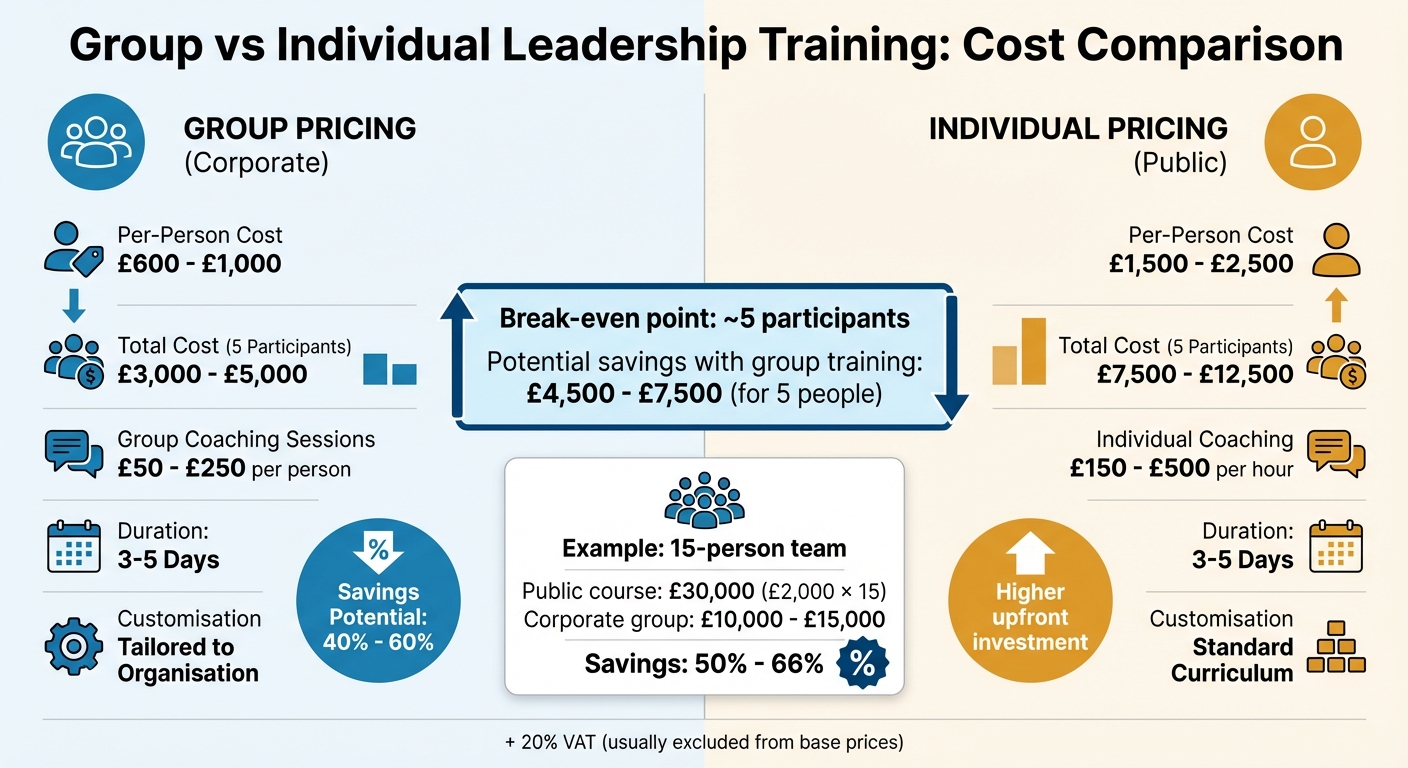
Group vs Individual Leadership Training Costs Comparison UK
Understanding how costs differ between group and individual training is essential for aligning your training budget with organisational goals. Individual training is charged per participant, meaning costs increase proportionally with the number of attendees. In contrast, group training involves a flat fee for the trainer’s time, which lowers the cost per participant as the group size increases. This distinction provides the foundation for the following cost breakdown.
"For a team of 15, customised corporate training is almost always more cost-effective per person. A public course at £2,000 per person would cost £30,000 for 15. A customised corporate program... might cost £10,000–£15,000". This translates into savings of 50–66% when opting for a group format. The break-even point typically occurs at around five participants.
Cost Comparison Table
| Metric | Individual Pricing (Public) | Group Pricing (Corporate) | Savings Potential |
|---|---|---|---|
| Per-Person Cost | £1,500 – £2,500 | £600 – £1,000 | 40% – 60% |
| Total Cost (5 Participants) | £7,500 – £12,500 | £3,000 – £5,000 | £4,500 – £7,500 |
| Duration | 3–5 Days | 3–5 Days | N/A |
| VAT Inclusion | Usually Excluded (+20%) | Usually Excluded (+20%) | N/A |
| Customisation | Standard Curriculum | Tailored to Organisation | High Value Add |
When it comes to coaching, group sessions also offer better per-person value. They typically cost between £50 and £250 per participant, compared to £150 to £500 per hour for individual coaching. While individual coaching provides a more personalised experience, group formats come with added benefits like peer learning and shared accountability, which can enhance outcomes.
If you’re considering training for five or more people, always request quotes for both per-person and flat-fee options. In most cases, the group rate proves to be the more economical choice.
sbb-itb-fa39ac2
Pros and Cons of Each Pricing Model
Expanding on the earlier cost breakdown, let's examine the strengths and weaknesses of each pricing model. The choice of model impacts cost, level of customisation, and training outcomes.
Group pricing provides excellent per-person value for live training sessions while fostering peer learning and diverse perspectives . This format is especially effective for middle managers and front-line supervisors, helping to develop team dynamics and establish a shared organisational framework . However, the content in group settings is often less tailored, with fixed schedules and limited confidentiality. These limitations make it less suited for senior leaders who may require a more personalised approach.
Individual pricing, on the other hand, focuses on one-to-one coaching with bespoke content designed to meet specific needs . This model ensures complete confidentiality and offers greater scheduling flexibility - qualities highly valued by senior executives and board members . However, the cost per person is significantly higher, and participants miss out on the collaborative problem-solving and networking opportunities available in group settings .
Studies suggest that the most effective training mix depends on the participant's seniority. For senior executives, a combination of 60% individual coaching and 40% peer group learning works best. In contrast, front-line managers benefit more from a mix of 20% individual coaching and 80% group training.
Comparison Table: Group vs Individual
The table below highlights the key differences between these two pricing models.
| Feature | Group Pricing | Individual Pricing |
|---|---|---|
| Cost per Person | Lower; ideal for live training sessions | Higher; reflects personalised focus |
| Personalisation | Standardised or modular content | Fully tailored to individual goals |
| Learning Style | Peer-to-peer interaction and networking | One-on-one focus; deeper personal growth |
| Flexibility | Fixed schedules for group sessions | High flexibility; tailored scheduling |
| Privacy | Limited; shared group environment | Full confidentiality; ideal for senior roles |
| Best For | Middle managers and front-line supervisors | C-suite executives and high-potential leaders |
Many organisations now favour a blended approach, combining group sessions to teach core skills with individual coaching to refine and apply those skills. This hybrid model offers a balance between cost-effectiveness and targeted development, particularly for organisations aiming to train leaders across different levels . The choice of pricing model should align with the organisation's goals and the seniority of the participants.
How to Choose Between Group and Individual Training
Factors to Consider
Deciding on the right training format involves weighing four key factors: the seniority of participants, team size, training goals, and budget. For C-suite executives or board-level leaders, individual coaching is often more effective. It ensures complete confidentiality, which is crucial for handling sensitive decisions. While individual coaching suits senior leaders who need a tailored and discreet approach, group training works well for emerging leaders, encouraging shared understanding and collaborative learning.
Team size also influences the cost-effectiveness of training. For one or two participants, public open sessions are usually the most affordable way to access live training. However, when training teams of 10 or more, bespoke corporate programmes often provide better value. These programmes can reduce the per-person cost significantly - sometimes cutting it in half compared to individual enrolments in public courses. Larger teams, such as those with 25 or more participants, may also benefit from volume discounts.
The choice between group and individual formats depends on the training objectives. Individual coaching is better suited for addressing personal development challenges, offering the psychological safety needed for deeper exploration. On the other hand, group training is ideal for building team cohesion and improving collective dynamics. As Barbra Carlisle, Founder of Glee Coaching, explains:
The downside is that deeper personal issues that are blocking leaders' views of themselves would not be explored in group coaching sessions, due to levels of psychological trust, the goals of the group coaching and time constraints.
While budget is a critical factor, it shouldn’t be the only consideration. A useful guideline is to allocate 5% to 10% of a leader’s annual salary towards their development. John Gave from The Metiss Group highlights the financial impact of investing in leadership development:
One underperforming senior leader can affect the output of dozens, sometimes hundreds, of people. Investing £20,000 in that leader's growth is often less costly than the attrition, disengagement, or performance loss that might occur otherwise.
Some organisations report a return on investment (ROI) of 5–7 times their coaching expenditure. Selecting the right provider is key to maximising the value of this investment.
Finding Providers Through Leadership Training Hub
Once you’ve identified your priorities, the next step is finding a provider that matches your needs. Leadership Training Hub simplifies this process by offering a comprehensive directory of UK leadership training and executive coaching providers. The platform enables organisations to compare options based on pricing models, delivery formats, and areas of expertise. Listings include both independent consultants and established training firms, with filters for audience seniority, budget ranges, and programme types - whether group workshops, individual coaching, or hybrid options.
Each provider profile details their pricing approach, such as whether they charge per session, per day, or offer package rates. This level of detail makes it easier to find options that suit your budget and team size, streamlining the decision-making process. By offering clear and upfront information, Leadership Training Hub helps organisations make quicker, more confident shortlists without the need for multiple exploratory calls.
Conclusion
Group and individual pricing models offer distinct advantages depending on what your organisation needs. Group training is often more cost-effective for larger teams, especially those with 10 or more participants. For instance, group sessions can significantly reduce the cost per delegate, making them a practical option for team-wide development. Additionally, hosting in-house sessions can help cut down on travel and accommodation costs.
On the other hand, individual coaching tends to have a higher upfront cost but provides the tailored focus and confidentiality that senior leaders often require. Choosing the right option depends on factors such as the seniority of participants, the size of your team, your training objectives, and your budget. Senior executives usually benefit most from one-to-one coaching, while group sessions often work well for emerging leaders, fostering collaboration and shared learning. Public courses are a good fit for very small teams, whereas bespoke corporate programmes are generally more cost-efficient for larger groups.
When considering costs, don’t forget to account for additional expenses like VAT, trainer travel, materials, and venue hire. Online delivery can save around £200 per delegate, and further discounts - such as block booking reductions of 5–15% or early bird savings of up to £100 per delegate - can help manage overall expenses. These factors can make a significant difference when weighing up your options.
To simplify the decision-making process, Leadership Training Hub provides a centralised directory of providers, complete with essential pricing details. You can filter options by delivery format, participant seniority, and budget range, allowing you to compare independent consultants and established firms side by side. Each provider profile includes clear pricing structures - whether per session, per day, or as part of a package - helping you quickly identify solutions that match your team size and budget, without the need for time-consuming exploratory calls.
FAQs
Should I choose group or individual leadership training?
Choosing between group and individual leadership training comes down to your organisation’s objectives, budget, and the outcomes you’re aiming to achieve. Group training works well for building team collaboration, encouraging shared behaviours, and promoting peer learning. It’s also a more budget-friendly option, with prices starting at £199 per person for public workshops or approximately £750 per person for private sessions.
On the other hand, individual training is tailored to specific roles or confidential challenges, offering a customised approach to personal development. However, this option tends to be more expensive, with costs starting at £300 per hour.
If your focus is on improving team cohesion or creating networking opportunities, group training is likely the better choice. For highly personalised development or addressing sensitive topics, individual coaching may be the way to go. Visit the Leadership Training Hub to compare providers, review pricing, and select the format that aligns with your needs.
What extra costs should I plan for when budgeting for leadership training?
When planning a budget for leadership training, it's essential to consider costs that go beyond the basic programme fee. These could include facilitator travel and accommodation, training materials, and any fees for customisation or intellectual property. Depending on the format and location, you might also need to budget for venue hire, catering, or equipment.
Accounting for these additional expenses upfront helps create a more precise budget and reduces the risk of unexpected costs later on.
What is the best mix of training options for different leadership levels?
The best training approach varies depending on leadership level and specific development goals. For emerging leaders and first-time managers, short group workshops or open courses lasting 1–2 days are a practical and budget-friendly choice. These sessions, which promote peer learning, typically cost between £300 and £800 per participant and can be easily scaled for larger groups within an organisation.
Mid-level managers often require more tailored solutions, such as in-house workshops lasting half or full days. These are generally charged as a flat trainer-day fee, ranging from £500 to £5,000 plus VAT. These sessions are ideal for addressing broader team needs, such as improving emotional intelligence or managing organisational change.
For senior executives, a more personalised approach is usually most effective. Options like executive coaching or accredited leadership programmes are designed to focus on high-level skills, including strategic decision-making and board-level influence. These services are typically billed hourly, from £100 to £2,000, or offered on a monthly retainer basis.
A well-rounded training strategy might combine group workshops for junior leaders, customised in-house programmes for mid-level managers, and one-to-one coaching for senior executives. This approach balances cost considerations with the specific needs of each leadership level.