Executive coaching costs in the UK vary significantly based on the seniority of the individual being coached. Fees for junior managers typically range from £500 to £850 per two-hour session, while senior executives and C-suite leaders can expect to pay between £850 and £1,475 per session. Full coaching packages for junior managers start at £4,500, with those for senior executives and C-suite leaders reaching up to £14,000. These differences reflect the expertise required and the complexity of challenges at each level. You can also use an executive coaching cost calculator to estimate specific budget requirements.
This article outlines pricing ranges, factors influencing costs, and return on investment (ROI) considerations for coaching across junior, mid-level, senior, and C-suite roles. For further details or to compare providers, visit Leadership Training Hub.
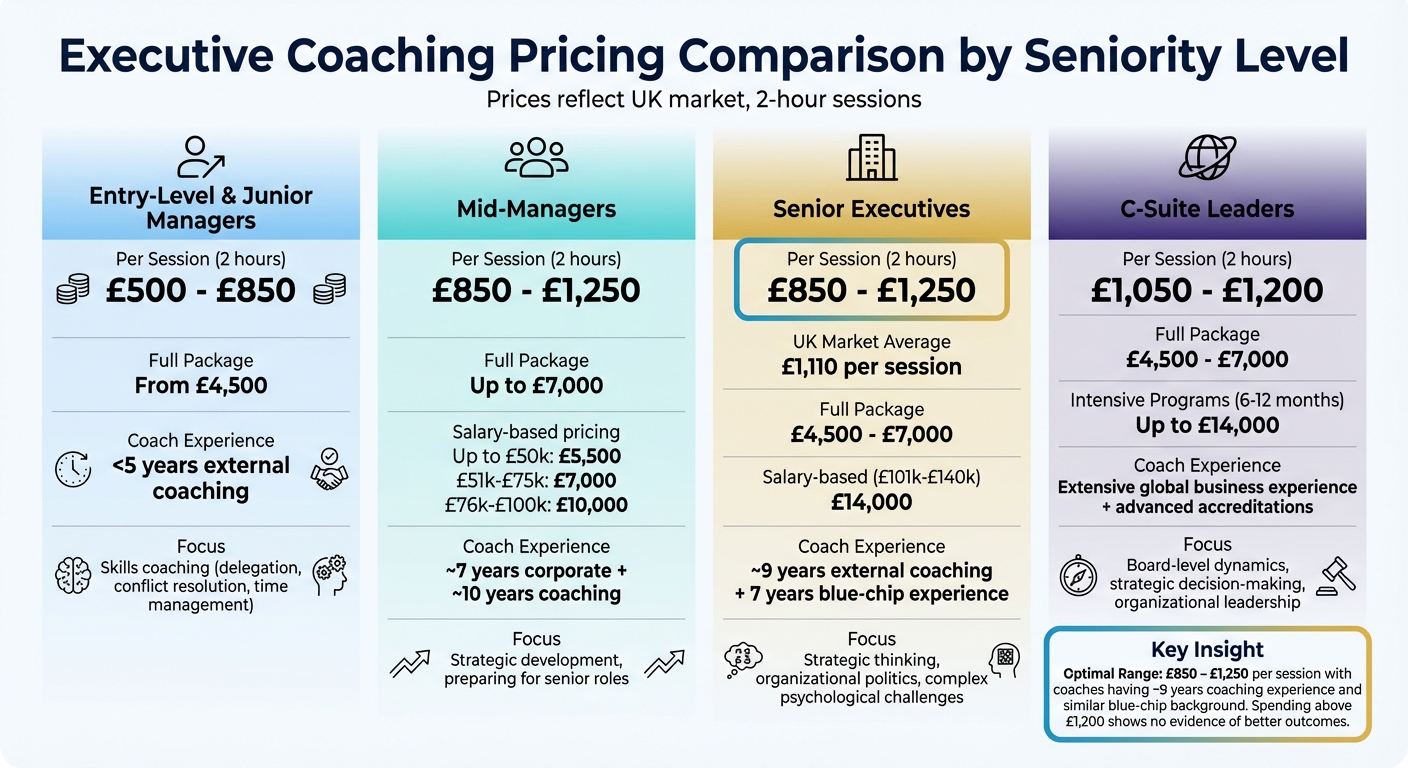
Executive Coaching Prices by Seniority Level in the UK
1. Entry-Level and Mid-Manager Coaching
Pricing Range
Coaching for entry-level and mid-manager roles typically falls at the more affordable end of the executive coaching spectrum, with fees depending on the coach's expertise and the coachee’s seniority. For junior managers and recent graduates, sessions are priced between £500 and £850 for a two-hour session. Mid-managers, however, can expect costs ranging from £850 to £1,250.
Some providers use the coachee's salary as a benchmark for pricing rather than their job title. For example, fees might start at £5,500 for those earning up to £50,000, increase to £7,000 for salaries between £51,000 and £75,000, and reach £10,000 for salaries between £76,000 and £100,000. Full coaching packages for junior managers generally begin at around £4,500, while mid-manager programmes can go up to £7,000, depending on the number and length of sessions.
These variations highlight the key factors that influence pricing at this tier.
Factors Driving Costs
The coach’s background and experience play a significant role in determining fees. Coaches charging between £500 and £850 often have fewer than five years of external coaching experience and typically come from middle management roles before transitioning into coaching. Their focus tends to be on "skills-coaching", addressing practical areas like delegation, conflict resolution, or time management, rather than delving into strategic or psychological development.
For mid-managers, coaching usually requires more seasoned professionals. Coaches in this category often have around seven years of corporate experience, often within blue-chip companies, and nearly a decade of external coaching practice. Their higher fees reflect both their credentials and the complexity of guiding managers as they prepare for senior leadership roles.
Return on Investment (ROI)
Organisations assess the value of coaching at this level by measuring improvements in leadership capabilities, better cross-functional collaboration, enhanced decision-making, higher staff retention, and stronger team engagement.
Budget approvals often hinge on linking the total investment to observable behavioural changes and their potential impact on revenue. Many organisations begin with pilot programmes for mid-managers to test the approach and refine it for their specific needs before committing to wider implementation.
These metrics help validate the financial commitment required for coaching at this stage.
sbb-itb-fa39ac2
2. Senior Executive Coaching
Pricing Range
Senior executive coaching typically commands higher fees due to the complexity of the role and the expertise required from the coach. Prices usually range from £850 to £1,250 per two-hour session, with the UK market average being around £1,110 per session.
Some providers base their fees on the executive's salary. For example, an executive earning between £101,000 and £140,000 might pay approximately £14,000 for a full coaching package. However, many top executive coaching programmes fall between £4,500 and £7,000, depending on the number of sessions and additional services offered.
Larger HR consultancies may charge more than £1,250 per session, but there’s limited evidence suggesting that these higher rates result in better coaching outcomes compared to mid-range providers.
Factors Driving Costs
The higher costs of senior executive coaching are driven by the elevated expectations for both the coach and the executive. Key factors include the coach’s professional background and experience. Coaches at this level typically have around nine years of external coaching experience and seven years of prior work in blue-chip organisations. This blend of corporate experience and coaching expertise justifies their higher fees compared to those coaching junior or mid-level managers.
Senior executive coaching goes beyond basic skill-building, focusing instead on areas like strategic thinking, navigating organisational politics, and addressing complex psychological challenges. Coaches are expected to understand the unique pressures of senior leadership and offer insights that extend far beyond standard management advice.
These factors highlight the tailored nature of senior executive coaching, setting it apart from other coaching levels and leading into the distinct demands of C-level coaching.
Return on Investment (ROI)
Measuring ROI for senior executive coaching involves four key areas: total investment, leading behavioural indicators, lagging commercial impacts, and overall organisational value. For example, a 12-month revenue leadership coaching programme costing approximately £150,000 might track early improvements such as better decision-making, enhanced cross-functional collaboration, and greater stakeholder confidence.
Longer-term indicators could include a 2–3% increase in win rates on strategic opportunities, improved retention of senior leaders, and higher engagement scores within the executive’s teams. As Mentor Group notes, establishing a clear, evidence-based link between coaching and organisational value is essential.
This structured approach to ROI assessment also sets the stage for understanding the even greater investment and expectations tied to C-level executive coaching.
3. C-Level Executive Coaching
C-level coaching takes the complexities of senior executive coaching to a higher level, addressing the unique challenges of top-tier organisational leadership and decision-making.
Pricing Range
C-level executive coaching is at the upper end of the leadership training costs in the UK. Fees for individual two-hour sessions typically fall between £1,050 and £1,200. For package deals, costs range from £4,500 to £7,000, while more intensive six-to-twelve-month programmes can reach up to £14,000 - particularly for executives earning between £101,000 and £140,000.
This pricing reflects the specialised nature of C-level coaching, as outlined below.
Factors Driving Costs
The higher fees for C-level coaching stem from the expertise and experience required to meet the demands of senior leadership. Coaches working at this level often have extensive experience in global business environments and hold advanced accreditations. They bring a deep understanding of board-level dynamics, strategic decision-making, and the pressures of leading an organisation. Unlike coaching for junior managers, which often focuses on skill-building, C-level coaching addresses broader, high-stakes challenges. As Lequin explains:
Quality coaching is nuanced and skilled, and requires many years of practice, supervision and training.
This level of expertise is rare, contributing to the premium pricing.
Return on Investment (ROI)
To measure the ROI of C-level coaching, organisations should focus on areas where leadership performance has the greatest impact. It is not advisable to use high-cost coaching to address underperformance or as a substitute for outplacement. Instead, the investment should target leadership development with the potential for significant organisational returns.
L&D managers can maximise value by observing coaching sessions to ensure they align with organisational goals. This helps differentiate genuine coaching from mentoring or advice-giving - an important distinction at the C-level, where the stakes and costs are particularly high.
Pros and Cons
The table below outlines the main advantages and disadvantages of coaching across different seniority levels, considering the pricing and quality factors discussed earlier.
| Seniority Level | Pros | Cons | Cost-Effectiveness |
|---|---|---|---|
| Entry-Level / Junior | Lower cost (£500–£850 per session); helps build essential skills. | Coaches may have less than five years' experience or be "hobbyists"; limited impact on strategic outcomes. | Good for basic skill-building but less effective for leadership development. |
| Mid-Manager | Strengthens the talent pipeline; prepares managers for senior roles; mid-range pricing. | Often used as a remedial tool rather than for strategic development. | Moderate; effectiveness depends on whether the coachee is high-potential or underperforming. |
| Senior / C-Level | Significant influence on organisational performance and culture; mitigates risks where leadership errors are costly. | High fees (£1,050–£1,200+ per session); potential for advice-based mentoring instead of coaching; no evidence that paying over £1,200 improves outcomes. | High, provided the coach meets stringent quality standards. |
This comparison shows that while coaching at lower levels is cost-efficient for building foundational skills, coaching at senior levels requires thorough vetting to ensure it delivers the desired impact. It’s also worth noting that coaching should not substitute proper outplacement support, especially for managers who are underperforming. As Lequin points out:
High quality executive coaching is not cheap, so being clear on which managers and leaders get coaching, and when, is important.
For senior and C-level coaching, the investment can be worthwhile when focusing on stakeholders whose decisions shape culture, strategy, and the livelihoods of many employees. Since quality coaching comes at a premium, organisations should prioritise their budgets for leaders whose performance drives the most significant returns, rather than those needing remedial intervention.
This summary can help organisations align their coaching investments with leadership impact and overall strategic goals.
Conclusion
The cost of executive coaching often correlates with the seniority of the leader being coached. Higher fees reflect the advanced expertise required to address the complexities at senior levels. Typically, effective coaching sessions range from £850 to £1,250, with coaches offering around nine years of experience in coaching and a similar background in blue-chip businesses. These qualifications often outweigh the importance of brand names or high-end pricing.
For organisations, allocating larger budgets to coaching senior leaders - those influencing culture, strategy, and performance - is a sound investment. While lower-cost coaching can help develop fundamental skills, it often lacks the depth needed for strategic leadership. As highlighted by Lequin, spending above £1,200 per session does not necessarily improve outcomes.
These points emphasise the importance of aligning coaching quality with leadership impact. Organisations should establish clear criteria for selecting coaches, observe their approach in practice, and confirm that they focus on coaching rather than mentoring or advising. Additionally, external coaching should not be used as a remedy for underperformance; internal management or outplacement support is better suited for such cases.
To explore tailored options for executive coaching across different seniority levels, visit Leadership Training Hub. The platform offers a UK-focused directory with filters for specialism, delivery format, and typical costs, helping organisations make informed shortlisting decisions.
FAQs
What should an executive coaching package include at my seniority level?
Executive coaching packages tailored to senior executives typically provide one-to-one sessions aimed at refining leadership skills, improving strategic decision-making, and enhancing overall organisational influence. For individuals at the CEO level or similar, these sessions often range between £1,050 and £1,200 for a two-hour session.
In addition to the coaching sessions, packages may include elements such as assessments, follow-up reviews, and personalised development plans. These often incorporate tools like 360-degree feedback and leadership evaluations, ensuring the programme addresses specific organisational challenges while focusing on measurable improvements.
How can we tell if a coach is genuinely qualified for senior or C-suite coaching?
Coaches specialising in senior or C-suite coaching typically bring at least five years of experience in executive coaching. They should have a track record of working with senior leaders at different levels and possess recognised accreditations, such as those from the International Coaching Federation (ICF) or the European Mentoring and Coaching Council (EMCC). Their competence is often demonstrated through observed coaching sessions and measurable outcomes.
What’s the simplest way to measure ROI from executive coaching?
To evaluate the return on investment (ROI) from executive coaching, start by examining clear, measurable outcomes. Look for improvements in areas like leadership performance, decision-making abilities, and noticeable behavioural shifts. These changes should connect directly to organisational metrics such as increased productivity, better employee retention rates, and positive stakeholder feedback. Concentrate on results that directly support your organisation's specific objectives.