Framework agreements are pre-negotiated contracts that simplify the purchase of leadership training by removing the need for repeated tendering. Commonly lasting up to four years, they establish pricing, terms, and quality standards upfront, making procurement quicker and more efficient. Under the Procurement Act 2023, open frameworks can extend to eight years, allowing new suppliers to join, which helps maintain competitive pricing.
These agreements reduce costs by using volume-based discounts, direct awards, and fixed pricing. For example, the Crown Commercial Service (CCS) framework has saved millions for public sector organisations by enabling bulk purchasing and streamlined processes. Leadership training buyers can benefit from reduced fees, shorter procurement cycles, and predictable budgets.
This article explains how framework agreements work, their cost-saving mechanisms, and examples of their use in the UK. For more details, visit the Leadership Training Hub to compare providers and find the right option for your organisation.
What is a Framework Agreement? Bid Writing Explained by Thornton & Lowe
Research and Data on Cost Savings
The examples below highlight how framework agreements have led to substantial cost savings, offering a practical approach to procuring leadership training.
Crown Commercial Service (CCS) Framework Results
In the financial year 2021/22, CCS frameworks delivered £2.8 billion in commercial benefits across the public sector, with total spending doubling to £27.6 billion over five years. These frameworks are instrumental in improving cost efficiency for leadership training. Jacob Rees-Mogg, then Minister for Brexit Opportunities and Government Efficiency, noted:
By leveraging the scale of public sector demand when choosing suppliers, these agreements have secured billions in savings, which can be used to support vital services delivered across the public sector
.
The CCS Managed Learning Services framework, awarded to Capita in July 2017, was projected to save the public sector £30 million over three years. This was achieved through tiered pricing models and a requirement that over 50% of the spending be subcontracted to specialist SME training providers. In 2021/22, SMEs benefited from over £2.2 billion in direct spending via CCS agreements, marking an increase of £687 million compared to the previous year.
Transport for London (TfL) Leadership Training Framework
Although specific savings data for leadership training is unavailable, the broader CCS framework model demonstrates how collective agreements can reduce costs. For instance, 14 NHS Trusts collectively saved £4 million on mobile and data services in 2021/22 by utilising CCS agreements. Similarly, the Student Loan Company achieved £1.6 million in savings by outsourcing print and mail services through the CCS Managed Print and Digital Solutions framework during the same period. These examples reflect the potential for similar cost efficiencies in leadership training procurement.
Local Authority and JISC Framework Examples
The Welsh Government introduced a Senior Leadership Coaching and Facilitation Services Framework in 2024, valued at up to £320,000 over four years. This framework ensures bilingual delivery in both Welsh and English while maintaining cost-effective access to coaching and facilitation services. Additionally, the Procurement Services Y25003 framework (2025–2029) offers direct award options and aggregated spend discounts. Even low-spend orders benefit from reduced pricing based on total contract value. These mechanisms, such as tiered pricing and fixed rates, further illustrate how leadership training costs can be effectively managed.
How Framework Agreements Reduce Costs
Framework agreements help reduce training costs through three main methods: volume-based pricing, simplified procurement, and long-term price stability. These mechanisms not only lower training fees but also cut administrative expenses. Below, we explore how these approaches work together to bring down leadership training costs in the UK.
Tiered Pricing and Bulk Purchasing
Framework agreements leverage volume-based pricing to secure lower rates. Suppliers often use tiered pricing models, where costs decrease as volume thresholds are met. This means organisations placing larger training orders enjoy reduced per-person rates without needing to negotiate separately. Additionally, frameworks enable multiple public sector bodies to combine their training needs, allowing smaller organisations to benefit from reduced pricing based on the total contract value. As Procurement Services explains:
You are able to benefit from aggregated spend and lower pricing based on the value of the overall contract, even on low spend orders
. By ensuring a consistent workflow, suppliers can also reinvest in their operations, which helps reduce administrative costs.
Direct Awards and Lower Procurement Costs
Direct awards simplify the procurement process by allowing organisations to work directly with pre-approved suppliers using pre-negotiated rate cards or pricing formulas. This eliminates the need for lengthy tender processes. What would typically take months can now be completed in days or weeks. The compliance and vetting requirements - such as checks on financial stability, technical ability, and certifications - are carried out during the framework's initial setup.
Framework projects also show cost consistency, with an average variance of just 1.4% between pre-tender estimates and final contract values. Preliminary costs are typically around 12.04% of the project value, compared to up to 20% in open market procurement. These streamlined processes also help maintain consistent pricing over time.
Fixed Pricing and Multi-Year Contracts
Framework agreements define pricing upfront or include mechanisms for determining costs. Most frameworks fix terms for up to four years, while newer open frameworks can provide price and term stability for as long as eight years. Key terms, including pricing structures, are locked in from the start, and call-offs adhere to these fixed terms. This protects organisations from unexpected price increases and allows for accurate multi-year budgeting.
Even if a framework expires, call-off contracts can extend beyond its term. This ensures that long-term leadership training programmes can be completed at the originally agreed rates.
sbb-itb-fa39ac2
Framework Agreement Comparison
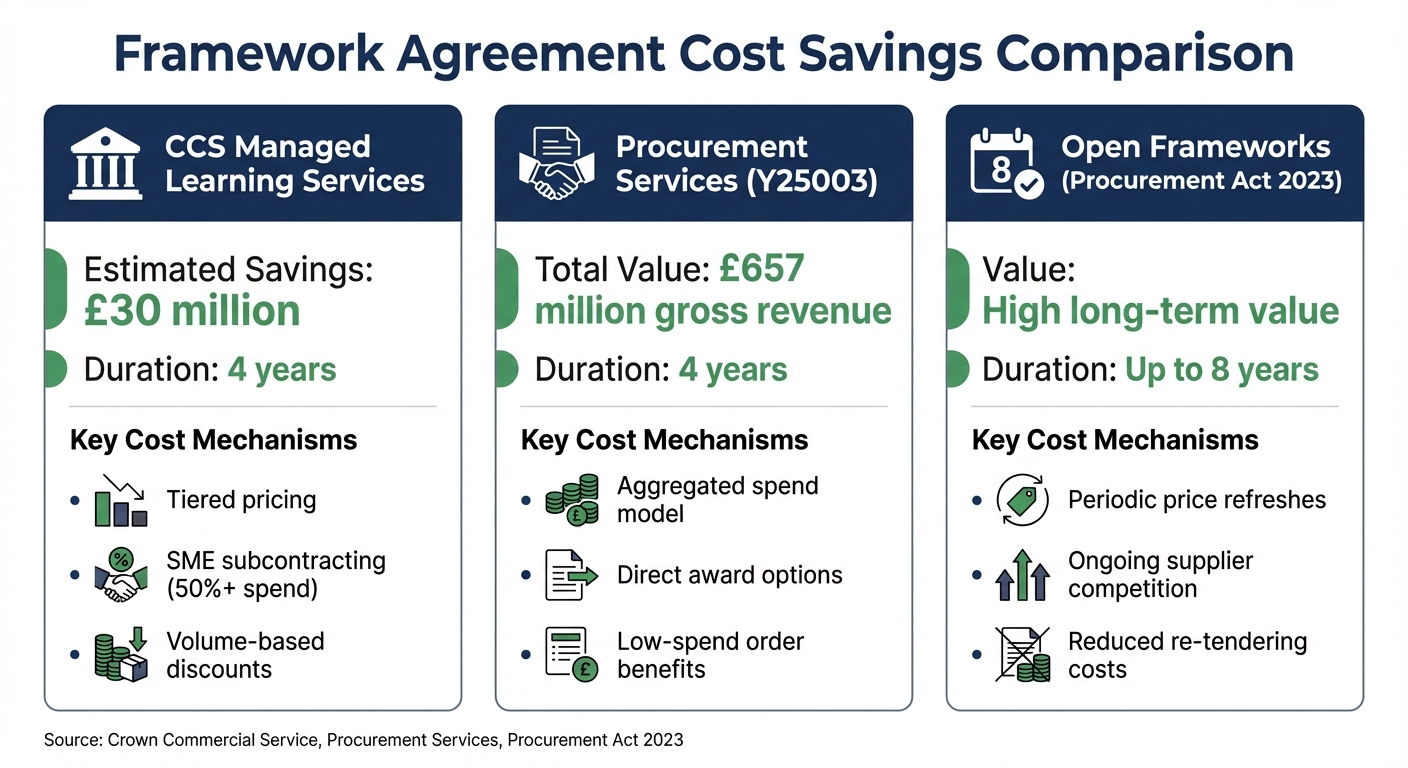
UK Framework Agreements Cost Savings Comparison for Leadership Training
Cost Savings by Framework
UK frameworks for leadership training procurement vary significantly in their cost-saving approaches and contract structures. The table below highlights three key frameworks, comparing their estimated savings, duration, and primary cost-reduction mechanisms.
| Framework Name | Estimated Savings / Value | Duration (Years) | Key Cost Mechanisms |
|---|---|---|---|
| CCS Managed Learning Services | £30 million | 4 | Tiered pricing, SME subcontracting |
| Procurement Services (Y25003) | £657 million gross revenue | 4 | Aggregated spend, direct award |
| Open Frameworks (Procurement Act 2023) | High long-term value | Up to 8 | Periodic price refreshes, competition |
Framework Summaries
Each framework employs distinct methods to achieve cost reductions, outlined below:
- Crown Commercial Service Managed Learning Services: This framework aims to save £30 million over a four-year period. It ensures over 50% of contract spend is subcontracted to smaller, specialist training providers, supporting SMEs while maintaining competitive pricing. The multi-tiered pricing model offers discounts as order volumes increase across leadership training services.
- Procurement Services' Training, Learning and Development Solutions (Y25003): Using an aggregated spend model, this framework enables even smaller organisations to benefit from pricing typically reserved for larger buyers. By pooling procurement volumes, it reduces costs across the board, ensuring accessible rates regardless of order size.
- Open Frameworks (Procurement Act 2023): With a duration of up to eight years, this framework stands out for its flexibility and long-term focus. It reopens periodically to introduce new suppliers and refresh pricing, maintaining competitive pressure throughout its lifecycle. This approach avoids the limitations of closed frameworks, which often lock in suppliers and pricing for shorter terms, such as four years. Open frameworks also help reduce re-tendering costs while keeping pricing competitive over extended contracts.
Conclusion
Framework agreements provide UK organisations with an efficient way to lower leadership training costs by leveraging aggregated spending, pre-approved suppliers, and tiered pricing structures. These agreements remove the need for repeated tendering, streamlining procurement processes and reducing administrative overheads. By offering competitive pricing, fixed terms, and multi-year contracts, they help organisations achieve both budget predictability and operational efficiency. Examples from CCS, Transport for London, and local authority frameworks highlight how this approach consistently delivers better value over time.
Under the Procurement Act 2023, open frameworks can remain active for up to eight years, allowing for periodic supplier updates to maintain competitive pricing without requiring a full re-tendering process. This flexibility ensures ongoing cost savings and process simplification.
For organisations looking to refine their leadership development strategies, working with pre-approved providers is essential. The Leadership Training Hub directory simplifies this process, enabling buyers to compare providers based on specialisms, delivery formats, and pricing models. This ensures that framework agreements are effectively aligned with organisational needs.
As George Cox & Sons note:
Framework agreements are rapidly becoming the preferred procurement route for forward thinking organisations. Choosing to invest in their supply chain and looking at the holistic benefits and savings instead of a cheap initial price
. By adopting framework agreements, UK organisations can secure a compliant and cost-effective solution for leadership training.
FAQs
How can framework agreements help UK organisations reduce leadership training costs?
Framework agreements offer UK organisations a practical way to cut costs on leadership training by establishing long-term relationships with providers. These agreements typically feature pre-agreed pricing, shielding organisations from future price hikes and ensuring stable rates over time.
By streamlining training requirements under one agreement, organisations can minimise administrative tasks and avoid the hassle of juggling multiple short-term contracts. Providers often pass on savings through economies of scale, enabling organisations to access high-quality training at a reduced cost per session.
How does the Procurement Act 2023 impact framework agreements?
The Procurement Act 2023 introduces updates to framework agreements, aiming to simplify procurement processes and boost efficiency. These changes are designed to make repeated purchases easier while ensuring adherence to the latest regulations.
Key updates include more precise requirements for the information frameworks must contain, simplified processes to encourage participation from newer suppliers, and steps to enhance transparency. For organisations sourcing services like leadership training, these changes can lead to time and cost savings over the long term.
How can framework agreements help SMEs save costs and improve efficiency?
Framework agreements offer small and medium-sized enterprises (SMEs) several practical benefits, particularly in terms of cost reduction and improving efficiency. By eliminating the need for repeated tendering, they streamline procurement, allowing SMEs to secure opportunities faster and at a lower cost.
These agreements also help SMEs establish long-term client relationships, providing more predictable revenue streams and encouraging ongoing development. Furthermore, they often simplify access to public sector contracts by pre-approving suppliers, making it easier for SMEs to compete for high-value opportunities. This approach not only simplifies processes but also helps SMEs strengthen their position in the market and achieve steady growth within the UK.