UK first-time manager training typically costs £325–£1,295 per person for open courses, though prices can fall outside this range. I compare online, classroom, accredited, in-house and blended options to help UK employers budget and shortlist providers.
Many one- or two-day courses cost £495–£995, usually plus VAT. At 20% VAT, a £495 fee becomes £594. Group programmes may use a fixed fee or day rate, so I compare costs using confirmed attendance, teaching hours and support.
I cover delivery choices, fee inclusions and <u>total payable costs</u>, with links to pricing guides, the first-time manager training category and directory listings to support your shortlist. Confirm current fees and VAT treatment before booking.
1. Live Online Open Courses
Fees and Pricing Basis
Published live-online fees typically range from £250–£795 + VAT per delegate, although some premium courses cost more. Before booking, compare course length, live teaching hours and how the fee is charged.
Published live-online format Fee per person, excluding VAT Total with 20% VAT One-day course £250 £300 Six weekly three-hour sessions £695 £834 Two-day first-time manager course £795 £954 Sources:.
Inclusions and Total Payable
Request a written list of what the fee includes, such as workbooks, certificates, recordings and follow-up access. Add VAT and any mandatory extras to calculate the invoice total. VAT-registered employers may recover VAT where eligible.
Delivery and Group Suitability
Live online means scheduled, trainer-led sessions on Zoom, Microsoft Teams or similar platforms - not self-paced course access.
Timetables vary: one two-day programme runs 09:00–16:30 UK time; a six-week programme delivers 18 live hours.
Check whether published hours include breaks, and confirm the fixed dates and UK time zone before booking.
This format suits an individual manager who wants live questions and discussion without travelling. If booking for several managers, compare the VAT-inclusive cost of all places with a private-group quote. Check how each option handles tailoring and private discussion.
Five places at £695 + VAT cost £4,170 including VAT.
sbb-itb-fa39ac2
2. In-Person Open Courses
Face-to-face open courses usually cost more once you include travel and time away from work. Compare fees alongside the full cost of attendance.
Fees and Pricing Basis
Published classroom fees range from £295–£1,620 + VAT per delegate.
At the lower end, Pure Human Resources lists a first-time manager course at £295 + VAT; at the upper end, Happy prices its two-day Management Fundamentals course at £1,620 + VAT, with lower rates for SMEs, public-sector organisations and charities.
Headline fees rarely cover the full classroom cost.
Inclusions and Total Payable
Including 20% VAT, fees of £395 and £790 become £474 and £948 respectively. ACAS lists face-to-face management training at £390 per person and says its events are VAT exempt.
Classroom fees often include materials, lunch or parking, but inclusions vary by provider.
Pure Human Resources includes course materials, refreshments and lunch in its £295 + VAT fee; The BCF Group includes lunch, refreshments and free parking in its £595 + VAT one-day course.
Check catering and dietary arrangements before booking. Budget separately for travel, accommodation and time away from work.
Delivery and Group Suitability
The higher cost buys live practice, role-play and immediate feedback. Open classroom courses are less suitable when employers need confidential discussions about internal policies or issues.
Impact Factory lists about 10 delegates for its two-day Line Management Course; Happy caps its Management Fundamentals course at 12.
When comparing providers, check group sizes and ask whether group discounts require all delegates to attend on the same date.
3. Accredited and Longer Open Programmes
Fees and Pricing Basis
Accredited programme fees cover assessment, supervision and study time, rather than attendance alone.
Indicative prices range from £495–£695 + VAT per delegate for one- to two-day courses to £1,570 + VAT for a six-day first-line manager programme. Compare qualification levels and assessment requirements alongside duration. An attendance or CPD certificate is not the same as an assessed management qualification.
Inclusions and Total Payable
Check what the accreditation fee covers before comparing headline prices.
The University of York quotes an average £1,500 per person with CMI accreditation, including membership, resources, tutorials, supervision, materials, refreshments and lunch. Its programme includes a 4,000-word assignment based on leadership tasks undertaken in the learner’s organisation. VAT treatment is not stated; confirm before budgeting.
Ask whether registration, marking, certification and resubmission charges are included. Post-course support also affects what you receive for the fee:
One £700 + VAT two-day programme includes digital course notes, an official training certificate, a post-course learning portal and three months of telephone coaching. Its invoice total is £840 at 20% VAT.
Delivery and Group Suitability
Allow for time away from work and study between sessions. Longer open programmes suit an individual manager or a small cohort who can commit to both.
The six-day example is split into three two-day blocks, while a separate 12-month CMI Level 3 Certificate lists 58–130 study hours plus assignment time.
Agree protected study time before booking. When comparing online, classroom and blended options, check the full time commitment - not just the advertised course days.
4. Bespoke In-House Programmes
Fees and Pricing Basis
Bespoke in-house training usually moves from per-person pricing to a group fee for teams that need the same content, shaped around their organisation. Check whether providers quote a fixed cohort fee, a trainer day rate or a per-person price. Compare scope, delivery and follow-up - not just the headline fee.
Published examples include £2,400 for up to 20 participants, £1,500–£3,000 per day, and £1,395 + VAT per person.
Inclusions and Total Payable
Ask providers to itemise needs analysis, design, preparation, delivery, materials, evaluation and support. Interviews, diagnostics and content based on your policies may cost extra.
One published schedule lists tailoring existing materials from £400, versus bespoke material preparation from £2,995 per day of materials development.
Include applicable VAT, travel, venue and cancellation charges when comparing the total payable.
A published rate of £1,245 + VAT per day for up to 12 delegates becomes £1,494 at 20% VAT, before separately agreed trainer travel and other charges.
Delivery and Group Suitability
In-house delivery suits managers who share training needs and need to practise using their organisation’s procedures. Published group limits are usually 4–12 delegates, although some providers allow 14 or 20.
One schedule covers 14 delegates at £2,995 per delivery day, then charges £195 for each extra attendee.
Request separate quotes for on-site and live-online delivery.
Published starting rates of £1,400 in person versus £1,150 online per group day differ by £250 before travel or venue costs.
Confirm session length, then divide the total fee by expected attendance to compare cost per manager. With a fixed group fee, fewer attendees mean a higher cost per person. For teams based across several sites, compare these options with hybrid delivery.
Use the directory’s leadership training listings to shortlist providers, check the in-house training category for group options, and compare quotes against the leadership training cost guide.
5. Hybrid and Blended Programmes
Fees and Pricing Basis
Prices depend on programme structure, rather than a simple mix of online and classroom rates.
One provider advertises live virtual or in-person group delivery for up to 15 people at a starting price of £4,800 plus VAT.
Fees usually reflect the number of sessions, delivery mix, participant numbers, customisation and support. Classroom, remote and self-study elements each affect licence costs and tutor time.
Request a written delivery breakdown covering teaching, study, assessment, peer activities, coaching and workplace assignments. It should separate included modules, platform access, tutor feedback and assessment from extras such as extended access, individual coaching, rescheduling, travel, venues and platform licences. These details affect the total invoice more than the delivery label. Use the directory’s cost and pricing pages alongside provider listings to compare charges.
Inclusions and Total Payable
Confirm who supplies the virtual classroom platform and what its licence covers. Check access duration, participant limits, breakout rooms, recording, captions, polling, mobile access, technical support, data protection and compatibility with your systems.
Ask what happens if a learner misses a live session: is a recording, repeat session or replacement activity included?
Delivery and Group Suitability
Hybrid delivery means some learners attend in person while others join the same session remotely. Blended delivery combines live teaching, self-study and workplace activity.
The mix affects travel costs and time away from work. Blended programmes can suit geographically dispersed teams or managers who cannot attend several consecutive classroom days, provided they have protected time for self-study.
Compare total learner time, travel and outcomes, not just workshop days. Remote participants must be able to take part fully in discussions and practice, and group numbers must stay within the provider’s limit.
Use the relevant directory category pages and provider listings to shortlist programmes by delivery format and group size. These costs also feed into the total-cost comparison below.
Total Costs: Inclusions, VAT and Extras
Compare total costs, not headline fees. Check VAT and extras, then record each item as included, included subject to scope, available at extra cost or not stated.
| Cost component | Open-course treatment | Bespoke or hybrid treatment | Questions to ask |
|---|---|---|---|
| Needs analysis and design | Usually fixed content; check pre-course diagnostics | Discovery, stakeholder consultation and tailoring may be charged separately | Are stakeholder interviews, custom case studies and design revisions included? |
| Facilitator preparation and delivery | Usually included in the delegate fee | May be charged as separate day-rate items | How much preparation time is covered? Is delivery charged separately? |
| Workbooks and digital materials | Standard resources are usually included | Custom materials may depend on scope | Are printed workbooks, downloads and post-course access included? |
| Certification, assessment and feedback | Check the awarding body, completion requirements, marking and feedback | Registration, diagnostics and reporting may cost extra | Are registration, certificates, reassessment, reports and feedback sessions included? |
| Coaching and 360-degree feedback | Do not assume these are included | May be optional extras | Does 360-degree pricing cover licences, invitations, reports and debriefing? How much coaching is included? |
| Action-planning and follow-up support | Check the support package | May depend on agreed scope | Are workplace reviews included? When does support end? |
| Venues, refreshments and equipment | Check the delegate package | Provided by the client or charged separately | Who pays for room hire, catering and presentation equipment? |
| Travel and accommodation | Delegate expenses generally sit outside the fee | Trainer expenses may be included or charged separately | Are mileage, fares, travel time and overnight stays included? |
| Platform licences and technical support | Check what the booking covers | May be charged separately | Are licences, technical rehearsal and troubleshooting covered? |
| Multi-site or multilingual delivery | Check availability and charges | Additional delivery and translation may cost extra | Are extra locations, interpreters and translated materials priced separately? |
| Cancellation and rescheduling | Booking terms determine charges | Contract terms determine charges | What are the deadlines and fees? Can delegates or unused places be substituted? |
Record prices exactly as quoted. Add 20% to prices marked ‘+ VAT’ or ‘excluding VAT’. Leave ‘VAT-exempt’ prices unchanged only when the exemption is confirmed. Request written confirmation of VAT treatment: accreditation does not determine it.
Total payable = training fee + chargeable extras + VAT where applicable
Illustrative invoice item Amount Training fee £495 Chargeable extras £100 Subtotal before VAT £595 VAT at 20% £119 Total payable £714 In this example, the net cost is £595 and VAT adds £119, giving a total of £714.
Keep employee time away from work, travel time and internal administration separate from the supplier invoice. These are internal costs.
Ask for a final quote showing cohort size, delivery hours, quote validity, payment terms, exclusions, pre-VAT subtotal, VAT rate, VAT amount and total payable. Before comparing providers from the directory listings and relevant category pages, check the cost and pricing pages and ask each supplier to confirm the same cost items, VAT treatment and cohort size. Use these confirmed totals to compare delivery formats in the next section.
Choosing a Format: Suitability and Break-Even Costs
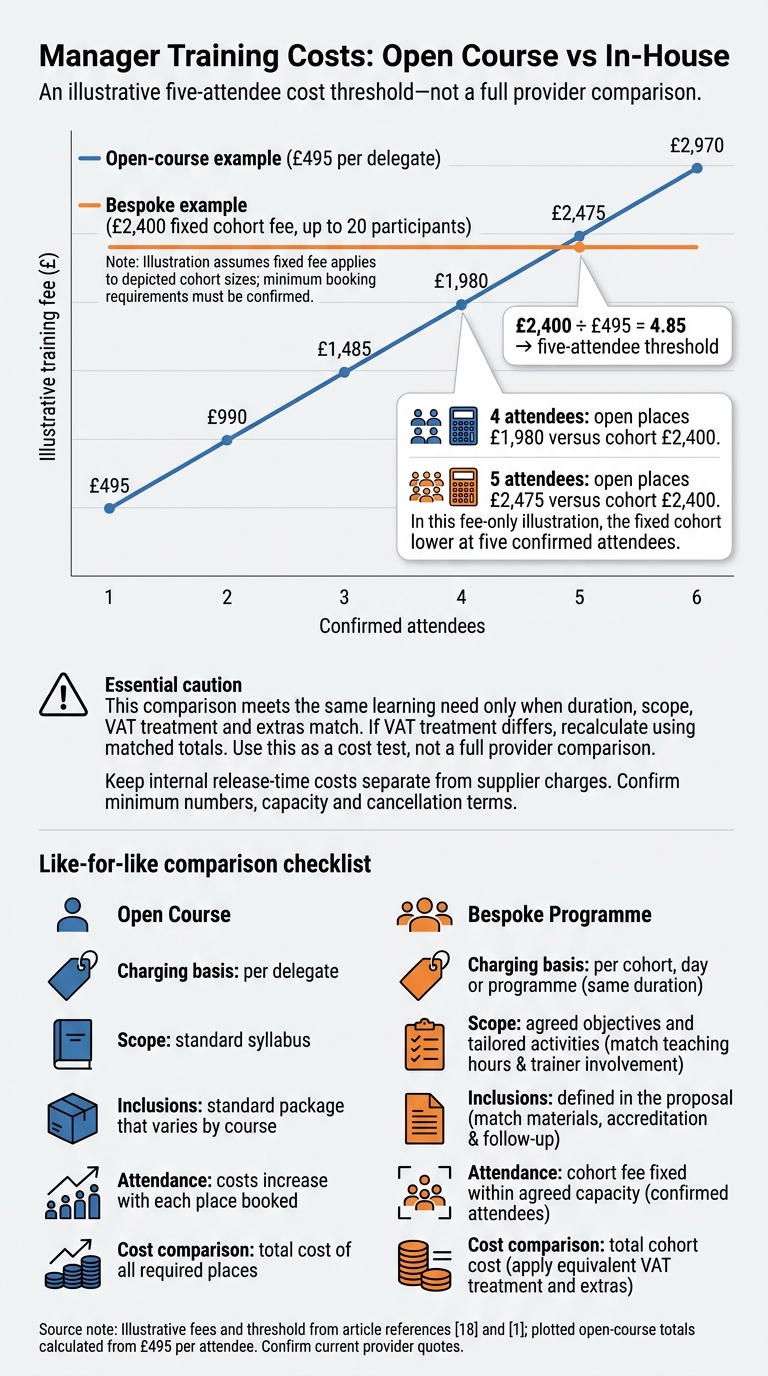
Manager Training Costs: Open Course vs In-House
Use the totals above to assess which format fits your needs, then compare the point at which a cohort fee costs less than individual places.
| Option | Best-fit buyer | Cohort requirements | Delivery pattern | Flexibility | Advantages | Disadvantages | Possible extra charges |
|---|---|---|---|---|---|---|---|
| Live online open course | One or a few managers needing individual places | Fixed dates; participants may come from different organisations | Usually one live virtual day or several shorter sessions | Limited choice of dates and content | No travel; access across the UK | Fixed dates, less organisation-specific discussion and possible technology constraints | Recordings or replacement materials |
| In-person open course | Individuals needing classroom practice and peer discussion | Individual bookings for a set date and venue | Usually a full-day classroom session | Fixed dates, location and agenda | Face-to-face practice and direct trainer support | Travel and time away from work | Parking, accommodation or meals outside the package |
| Accredited or longer open programme | Employers seeking structured development or recognised learning | Individual or small-group enrolment; attendance, assignments or assessment may be required | Sessions over weeks or months, often with self-study | Less diary flexibility | More reinforcement and formal evidence of learning | Longer commitment and assessment workload | Registration, assessment or resit fees |
| Bespoke in-house programme | Employers with shared management challenges | Closed cohort; minimum numbers, maximum capacity and sometimes a minimum fee apply | Client-specific, provider-led sessions, online, in person or both | High control over examples, dates, objectives and activities | Shared language, confidentiality, team relevance and no separate learner bookings | Higher upfront commitment; may offer poor value for a very small cohort | Discovery, design, custom materials and tailored evaluation |
| Hybrid or blended programme | Distributed teams needing flexibility and facilitated practice | Attendance at live sessions; mixed-location groups need suitable rooms and technology | Online and classroom sessions, self-paced learning and workshops, or several live sessions | Self-study around scheduled workshops | Combines access with practice, reflection and reinforcement | More coordination, learner tracking and technical risk | Platform licences, recording access or additional facilitation |
Check booking and delivery terms before comparing fees: minimum numbers, cancellation terms and what happens if a scheduled course does not run. For accredited programmes, confirm assessment deadlines. For blended delivery, check licence terms, recording access and who supplies rooms and equipment.
Once you have chosen a suitable format, compare open-course and cohort costs on the same basis.
| Comparison point | Open-course pricing | Bespoke pricing | Break-even consideration |
|---|---|---|---|
| Charging basis | Per delegate | Per cohort, day or programme | Check that both fees cover the same duration |
| Scope | Standard syllabus | Agreed objectives and tailored activities | Compare teaching hours and trainer involvement |
| Inclusions | Standard package; varies by course | Defined in the proposal | Match materials, accreditation and follow-up |
| Attendance | Cost increases with each place booked | Fixed fee within agreed capacity | Use confirmed attendees, not potential learners |
| Cost comparison | Total cost of all required places | Total cohort cost | Apply equivalent VAT treatment and include extras |
£2,400 ÷ £495 = 4.85, giving a five-attendee threshold. This comparison meets the same learning need only when the duration, scope, VAT treatment and extras match. Use this only as a cost test, not a full provider comparison.
If VAT treatment differs, recalculate using matched totals.
For one or two managers with an immediate need, first-time manager open-course places are usually the simplest option. For a stable cohort with shared internal processes, request a bespoke quote against the same learning specification. Assess hybrid programmes by their mix of live teaching, self-study and classroom sessions - not the label. Keep internal release-time costs separate from supplier charges.
Conclusion: Build a Like-for-Like Training Shortlist
Build your shortlist using the confirmed totals above. Give each provider the same buying brief: learning hours, cohort size, inclusions, VAT treatment and core first-time manager topics. Choose open courses for individuals, bespoke delivery for shared team needs, or hybrid programmes when managers need practice between sessions. Ask each provider to confirm how its programme meets your brief.
Use the UK directory and provider listings to filter by provider type, specialism, audience, delivery format and typical fee. Request written quotes from suitable providers covering scope, total payable cost, availability, cancellation terms and the quote expiry date.
FAQs
How can I measure the return on manager training?
Agree clear, measurable SMART objectives before first-time manager training starts. Use diagnostic tools and leadership assessments to identify development needs and track progress.
Measure changes in team productivity, which can increase by 20% to 35%, and staff turnover, which can fall by 10% to 15%. Assess return on investment (ROI) by comparing training costs with the gains achieved, including higher employee engagement.
Is accredited training worth the extra cost?
Accredited training may justify the extra cost if you need nationally recognised qualifications that confirm management expertise. Certification fees can add £500 to £1,000 or more per participant, though programmes often include digital resources, networking, mentoring and professional membership. When comparing leadership training providers, check which extras are included and compare programme costs.
For organisations, accredited frameworks help maintain consistent quality and recognised standards across larger groups. UK employers can often use the Apprenticeship Levy to cover up to 100% of eligible training costs, subject to funding rules.
How can I reduce costs without compromising training quality?
Hybrid and virtual formats can reduce travel and venue costs. For groups of ten or more, in-house sessions can cost less per person than open courses.
For recurring training needs, flat-fee company licences or framework agreements can provide volume discounts and stable pricing. Government-backed schemes, such as the Apprenticeship Levy, may cover 95% to 100% of eligible programme costs.
Use diagnostic tools to identify development gaps and focus spending on measurable outcomes. Compare delivery options in the leadership training category, check costs and pricing, and review provider listings for suitable programmes.