UK executive coaching retainers typically cost £800–£2,400 per month for scheduled sessions and agreed between-session support. I use these figures as budget guides, not confirmed provider quotes.
For HR teams, founders and senior leaders, I compare session time, coach experience, access limits and delivery format alongside price. <u>Total contract cost</u> matters more than the monthly fee: check the minimum term, assessment charges, travel expenses and whether 20% VAT applies.
In this guide, I compare options across leadership levels and explain what to check before signing. Start with our executive coaching costs pages, then browse the executive coaching category and directory listings to shortlist providers and request like-for-like quotes.
1. Retainers for Emerging and Aspiring Leaders
Fees and Contract Costs
Budget £800–£1,200 per month for a focused retainer covering two 60-minute sessions, notes and email support. A six-month commitment costs £4,800–£7,200 before VAT, or £5,760–£8,640 if standard-rate VAT applies.
Check the minimum term, renewal rules, unused-session policy and any setup or assessment fees. At this price, you are mainly paying for structured support rather than broad access to the coach.
Sessions and Coach Access
Fortnightly sessions suit preparation for a first promotion and the early stages of a new role. Agree the outcomes you want to work towards:
A 90-day transition plan, better delegation or more effective stakeholder conversations.
Ask for action notes and a progress review. Agree email response times, and do not assume phone access is included. Packages costing £1,200–£1,800 per month may include longer sessions, email or telephone access and assessments. Check whether these extras support your goals.
Coach Fit and Experience
Once you have agreed the scope, compare coaches’ experience with first-time managers, managing former peers and influencing without authority.
Ask about International Coaching Federation (ICF) or European Mentoring and Coaching Council (EMCC) credentials, supervision and anonymised evidence of work supporting one-on-one coaching for executive transitions. If your employer pays for the retainer, agree confidentiality terms and which progress information the coach can share.
Delivery and Expenses
Online sessions avoid travel and venue costs, though the coaching fee may stay the same. A hybrid format - an initial meeting in person followed by video sessions - limits travel to the first meeting.
For face-to-face coaching, ask for travel time, fares, accommodation and venue hire to be itemised. Use the executive coaching category to browse directory listings, then compare package inclusions against the cost and pricing pages.
sbb-itb-fa39ac2
2. Retainers for Directors and Heads of Department
Director-level retainers cost more because coaching covers broader stakeholder demands and larger business decisions.
Fees and Contract Costs
Director retainers usually fall in the upper half of the £800–£2,400 monthly range, reflecting broader stakeholder work and, sometimes, assessment fees. Across the full range, a six-month contract costs £4,800–£14,400 before VAT, or £5,760–£17,280 if 20% VAT applies. More coach access and assessment work tend to push fees towards the upper end.
Request a written total with assessment fees shown separately. Confirm the minimum contract term rather than assuming it is six months.
Sessions and Coach Access
Expect one or two 60- to 90-minute sessions a month, usually fortnightly. Fortnightly sessions may suit a restructure, transformation or performance issue. Monthly sessions may be enough for longer-term planning and accountability. Compare session frequency and between-session support when reviewing fees.
Agree two or three measurable outcomes, such as:
Better cross-functional decisions, delegation, succession planning or better leadership-team alignment.
Higher-priced packages may include email or telephone support, session notes, action tracking, psychometrics and stakeholder work. Agree response times and usage limits. If the package advertises an annual 360-degree review, check whether a shorter contract includes it.
Executive Fit and Coach Experience
A coach with relevant departmental experience can link development to business outcomes and understand complex stakeholder demands. Experience in finance, operations, technology or HR may matter more than prestige alone, and can affect the price.
Session rates range from around £200–£400 for experienced coaches to £500–£1,500 or more for board-level specialists. Confirm session length and how the coach protects confidentiality.
Delivery and Expenses
Check whether stakeholder interviews, sponsor meetings and in-person reviews count as coaching time or incur separate fees. Ask whether in-person work carries extra charges for travel time, mileage, rail fares, accommodation or venue hire.
Use Leadership Training Hub’s executive coaching listings to shortlist providers by audience fit and delivery format, then request quotes with a like-for-like scope.
MD and C-suite retainers usually include more coach access, board-level input and between-session contact.
3. Retainers for Managing Directors, CEOs and C-Suite Leaders
Fees and Contract Costs
C-suite retainers typically fall into three price bands: £800–£1,200 a month for core support, £1,200–£1,800 for more access and 360 feedback, and £1,800–£2,400 for premium support, psychometrics and stakeholder work. Higher fees tend to cover more board exposure, faster responses and stakeholder work. These are indicative bands, not a UK average.
Six- to 12-month contracts are common. At £1,800 a month, a six-month contract costs £10,800 before VAT, or £12,960 with 20% VAT, where applicable.
Check whether onboarding, assessments, stakeholder interviews, reporting, cancellation fees and renewals cost extra. Confirm whether unused sessions roll over and what notice you must give.
Compare the full contract cost, including the term, VAT and extras, rather than the monthly fee alone. Use the directory’s executive coaching listings and cost and pricing pages to compare options.
Sessions and Coach Access
Typical packages include two sessions a month, notes and email support. Higher tiers add phone access, 360 feedback, psychometrics and stakeholder work. For C-suite retainers, also compare the board-level input available and expected response times.
Specify whether between-session access means email, scheduled calls or urgent support. Any ‘unlimited’ access should have agreed response times and reasonable-use limits. Check whether urgent or out-of-hours support costs extra. Price advice, crisis support or organisational consulting separately from coaching if these are part of the brief.
Executive Fit and Coach Experience
Look for coaches who have worked with boards, investors, restructures, international teams, succession or rapid growth. Match their background to your brief: a former CEO brings commercial context, while an accredited coach brings a structured coaching process. Experience of similar pressures often matters more than brand prestige alone.
Agree measurable outcomes at the start, such as:
Improved board communication, faster decision-making, stronger delegation, reduced leadership derailers or progress against strategic priorities.
Review progress using baseline goals, confidential self-assessment, selected stakeholder feedback at the midpoint and an end-of-engagement review. Keep private coaching content confidential. Compare relevant experience through the directory’s executive coaching category before shortlisting.
Delivery and Expenses
Online coaching suits frequent check-ins; in-person work suits relationship-building, transitions and sensitive issues. Hybrid delivery can combine monthly video sessions with occasional face-to-face meetings.
Travel, venue hire and face-to-face time can push a retainer beyond your budget. Ask whether travel time, fares, accommodation, venue hire and mileage are included. Confirm whether in-person days count as coaching sessions or cost extra.
Monthly Fees, Contract Terms and Total Costs
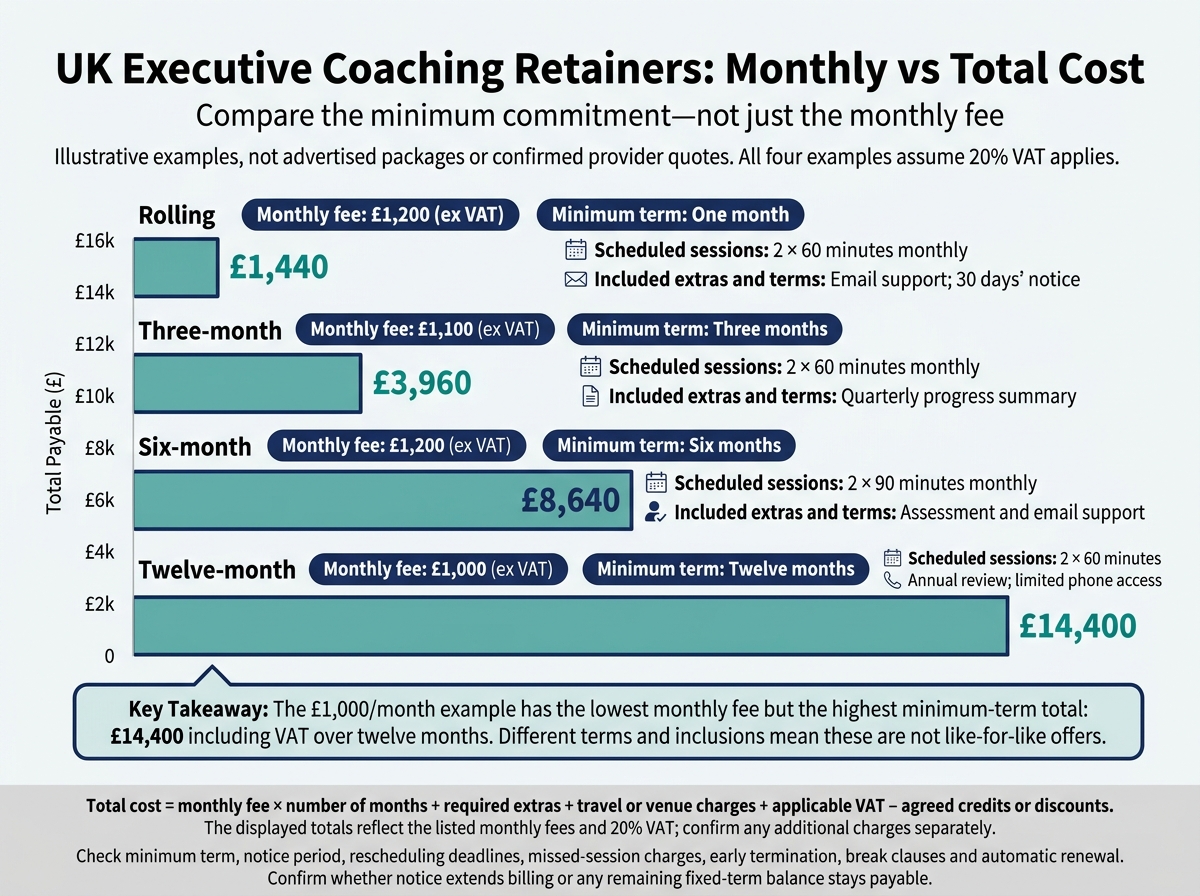
UK Executive Coaching Retainers: Monthly vs Total Cost
Start by comparing the minimum term, notice period and total contract cost. Check whether each quote includes VAT. The examples below are illustrative, not advertised packages, and provide a basis for comparing quotes across seniority levels and contract lengths.
| Category | Monthly fee (before VAT) | Minimum term | Scheduled sessions | Included extras and terms | VAT assumption | Total payable for minimum term |
|---|---|---|---|---|---|---|
| Rolling | £1,200 | One month | 2 × 60 minutes monthly | Email support; 30 days’ notice | 20% VAT applies | £1,440 |
| Three-month | £1,100 | Three months | 2 × 60 minutes monthly | Quarterly progress summary | 20% VAT applies | £3,960 |
| Six-month | £1,200 | Six months | 2 × 90 minutes monthly | Assessment and email support | 20% VAT applies | £8,640 |
| Twelve-month | £1,000 | Twelve months | 2 × 60 minutes monthly | Annual review; limited phone access | 20% VAT applies | £14,400 |
Calculate the total cost by adding monthly fees, required extras, travel or venue charges and VAT, then subtracting agreed credits or discounts.
Ask for written contract terms covering rescheduling deadlines, missed-session charges, early termination, break clauses and automatic renewal. Confirm whether the notice period extends billing and whether any remaining fixed-term balance stays payable.
Assess between-session support by the contact allowance, response times during office hours and usage limits - not vague promises of access. Use Leadership Training Hub’s cost and pricing pages to compare packages, then browse the executive coaching directory to shortlist providers and request itemised quotes on the same basis.
Next, compare package inclusions, coach fit and delivery format.
Package Inclusions, Coach Fit and Delivery
Once you know the monthly fee, check what it covers. The scope of support helps explain price differences between retainers. Compare this alongside the fees on the executive coaching costs page.
Sessions and Between-Session Access
Use the table to check inclusions rather than assume them. Packages differ by provider; premium tiers often add assessments and stakeholder work. Ask providers to mark each item as included, excluded or charged separately.
| Confirm in quote | Possible extra cost |
|---|---|
| Session frequency, length, preparation and notes | Additional sessions or preparation |
| Contact channels, hours, response times and usage limits | Out-of-hours support or access beyond agreed limits |
| Progress reviews, action plans and reporting | Additional reports or sponsor meetings |
| Assessments, stakeholder interviews and feedback | Licences, interviews and debriefs unless included |
For assessments, confirm the name, licence cost, participant count, report format and who owns the results. Any ‘unlimited’ access must have contractual limits.
Leadership Needs and Coach Experience
Match the coach’s experience to the complexity of the work, not just the executive’s job title. A higher price does not guarantee a better fit.
When reviewing directory listings, check relevant experience, accreditation, supervision, insurance, conflicts of interest, confidentiality and availability. Agree measurable objectives and reporting boundaries. Employers should receive only agreed progress information, not session content.
Delivery format affects costs mainly through travel, venue charges and time commitments.
Online, In-Person and Hybrid Coaching
| Format | Cost drivers and travel | Scheduling impact | Relationship-building and access levels |
|---|---|---|---|
| Online | Expertise, assessments and access still drive fees; no travel does not guarantee a lower price | Easier scheduling across locations | Check comfort with video; messaging access is separate |
| In-person | Travel time, expenses and venue hire may increase total cost | Allow for travel and venue availability | Face-to-face contact; no automatic extra access |
| Hybrid | Confirm charges for each in-person or assessment day | Remote sessions plus planned travel | Face-to-face meetings with remote continuity; access remains contractual |
To compare total contract costs, specify location, session frequency, availability, participant count, assessments, stakeholder work and in-person days. Confirm whether travel time, expenses, venues and sponsor reporting are included or charged separately.
When shortlisting through the executive coaching category, focus on support the executive will use rather than the highest-tier label.
Choosing a Retainer That Fits Your Budget
After comparing seniority bands and package scope, use Leadership Training Hub directory pages and provider listings to shortlist by seniority, leadership need, relevant coach experience and the access you expect to use. Treat typical costs as an initial budget check, and confirm final fees in writing.
Send the same written brief to two or three providers. Include seniority, objectives, delivery format, start date, contract length, session frequency and between-session access. Ask for itemised quotes so you can compare like for like. Assessments, travel, accommodation or venue costs excluded from the quote may make a lower monthly fee more expensive overall.
Compare the full contract cost: monthly fee × number of months, plus one-off charges, expenses and applicable VAT.
Before signing, confirm these points in writing:
- Session length, access limits, response times, exclusions and extra charges.
- Minimum commitment, payment and renewal terms.
- Confidentiality, employer-reporting boundaries and agreed review points.
- Cancellation, rescheduling, unused-session and early-termination terms.
FAQs
When is a retainer better value than paying per session?
A retainer is generally better value if you need regular, long-term coaching or support for several executives. It often includes sessions, initial assessments, follow-up calls, email support and progress reviews. This typically reduces the cost per session compared with booking sessions separately.
Retainers can also suit organisations going through major change or needing regular, on-demand access to a coach.
Can I negotiate a shorter coaching commitment?
You can often negotiate coaching terms. Independent consultants may adjust their rates and programme structure to fit your organisation’s budget and needs.
If you’re unsure about a long-term commitment, ask about an initial diagnostic phase to assess your needs. Another option is a shorter, goal-focused package: three to four sessions over three months is often enough to address a specific, time-bound challenge.
How can I measure my coaching retainer’s value?
Assess your coaching retainer against business outcomes, not just its hourly cost. Set baseline measures using 360-degree feedback or performance KPIs, then track changes in employee retention, team performance, decision-making quality and engagement scores.
Include line managers in joint goal-setting and reviews so coaching stays aligned with your organisation’s goals. Use the results to assess the return on your investment and its long-term impact.