Enterprise coaching in the UK is designed for organisations aiming to develop middle and senior leaders through tailored coaching programmes. Costs for these services vary based on factors like session format, programme scale, and customisation levels. Individual two-hour executive coaching sessions typically range from £1,050 to £1,200, while group coaching and in-house programmes offer more cost-effective options for larger teams.
This article outlines key cost components, including session fees, programme structures, and additional expenses, helping HR and L&D leaders budget effectively. Explore detailed pricing comparisons and delivery format options to identify the best-fit coaching provider for your organisation.
Visit our directory for a comprehensive list of UK-based enterprise coaching providers.
Session Fees Breakdown
UK enterprise coaching fees are generally structured around two-hour sessions, allowing for thorough exploration and measurable progress. This approach contrasts with personal coaching, which often charges by the hour. Understanding how these fees are calculated is crucial for organisations to budget effectively and make fair comparisons between providers. Below, we break down the key factors influencing enterprise coaching costs, including hourly rates, package commitments, and volume discounts.
Hourly Rates for Executive Coaches
For enterprise coaching programmes, hourly rates vary depending on the level of expertise required:
- Junior executive or skills-focused coaching: £250–£425 per hour
- Senior executive coaching: £425–£625 per hour
Premium consultancy rates can exceed £625 per hour, but research suggests that paying above this level does not necessarily improve coaching outcomes. As highlighted by Lequin:
"A reasonable rate for high quality executive coaches, in our view, is £1050 to £1200 per two-hour executive coaching session in the UK. There is no evidence to suggest that paying more than this gets you a better coach."
These benchmarks provide a foundation for understanding the pricing of broader coaching packages.
Minimum Session Packages
Most enterprise coaching providers require a minimum package commitment rather than offering one-off sessions. While entry-level packages may start at around £185 for a one-hour session, executive-level coaching typically involves a series of sessions priced between £4,500 and £7,000. This ensures a consistent and structured approach to development.
Initial consultation fees vary, often ranging from £0 to £300, depending on the provider. Additionally, tiered packages often lower the per-session cost, making them a more economical choice for organisations planning long-term coaching initiatives.
Volume Discounts for Enterprises
Larger organisations often benefit from custom pricing and discounts based on the scale of their coaching needs. While individual bookings follow standard rates, enterprise clients usually receive tailored quotes that account for the size and complexity of the engagement. Group coaching offers a cost-effective alternative, with prices per participant ranging from £200 to £1,000, compared to £1,500–£3,000 for one-to-one sessions.
To streamline costs and maintain quality, many global businesses establish coaching pools - pre-approved networks of external coaches with standardised rates. This approach simplifies procurement processes and helps HR teams manage budgets more effectively when rolling out coaching programmes for 10 or more leaders simultaneously.
Programme Duration and Structure Costs
Enterprise coaching programmes in the UK typically follow set timeframes. The overall cost depends on session frequency and whether organisations opt for fixed-term plans or retainer agreements. This structure helps align budgets with strategic priorities. Below is a breakdown of costs based on programme duration and session formats.
3-6 Month Programmes
For programmes lasting 3 to 6 months, participants usually attend six to twelve sessions, each lasting two hours. Costs range from approximately £4,500 to £15,000 per leader. Some providers offer packages based on seniority, priced between £4,500 and £7,000, while others use salary-linked pricing where fees are tied to the coachee’s earnings.
Salary-linked models adjust costs according to leadership roles. For instance:
- A leader earning up to £50,000 might pay around £5,500.
- Those earning between £76,000 and £100,000 could see costs rise to £10,000.
- Senior executives with salaries exceeding £101,000 might incur fees of £14,000 or more.
It’s worth noting, however, that paying higher rates doesn’t necessarily equate to better coaching outcomes.
Annual Retainers
For organisations seeking ongoing support, retainer agreements provide extended coaching benefits. Retainers typically start at monthly fees of around £200 and focus on long-term goals and accountability. As Morgan Lee from ActionCOACH explains:
Simply surrounding yourself with people or a coach who knows more than you can help uncover knowledge gaps, which could benefit you tenfold.
While retainers require a lower monthly financial commitment compared to intensive one-to-one packages, organisations should budget for the full annual cost, which can range between £2,400 and £6,000 or more, depending on the level of access and support offered.
Multi-Session Packages
One-to-one coaching packages are available for £1,500 to £3,000. Smaller bundles can offer cost savings: for example, a single one-hour online session might cost £185, whereas a six-session package is priced at £875, reducing the per-hour rate by about 21%. These packages often include extras such as:
- Pre-programme consultations
- Email support between sessions
- Access to coaching materials or frameworks
For organisations with multiple leaders, volume discounts may be available. Additional features like diagnostic tools, progress tracking, and administrative support can add value but may also increase the overall cost. It’s also important to check if VAT applies, as this can add 20% to the final bill depending on the provider’s tax status.
Delivery Format Cost Variations
The format in which coaching is delivered plays a major role in determining its cost. As Morgan Lee from ActionCOACH explains:
The biggest cost decider between affordable and premium business coaching is the actual coaching format.
In-person coaching tends to be 15–30% more expensive than virtual options, largely due to travel and venue-related expenses. Virtual coaching avoids these additional costs, making it a practical choice for organisations with geographically dispersed teams. These differences allow organisations to choose the format that best aligns with their budget and objectives.
In-Person Coaching
Face-to-face coaching comes with the highest price tag. In the UK, a typical two-hour executive coaching session costs between £1,050 and £1,200. Coaches based in London often charge £200 to £500 per hour, depending on their credentials and reputation. Additional travel-related expenses, such as rail fares, mileage, parking, and even the coach’s travel time, further increase the cost. If your organisation cannot provide a meeting space, hiring external venues like professional suites or hotel facilities will add to the overall expense. Rescheduling or cancelling a session can also incur fees ranging from £50 to several hundred pounds, as coaches must be compensated for their time and any travel arrangements already made.
Virtual and Group Coaching
Virtual coaching eliminates the need for travel or venue hire, resulting in more affordable rates. Group coaching programmes, such as ActionCLUB, typically cost between £200 and £1,000 per participant and focus on core business skills in a collaborative setting. This is a cost-effective alternative to private one-to-one coaching, which usually ranges from £1,500 to £3,000 per programme. For organisations with several leaders to train, virtual group coaching offers a scalable solution without compromising on quality.
Hybrid Coaching for Enterprises
Hybrid coaching combines virtual group sessions with occasional in-person meetings, offering a balance between cost savings and personal interaction. This format is particularly effective for organisations with 10 or more leaders, as it allows for flexible, semi-customised plans that fall between standard group training and high-cost individual coaching. Hybrid programmes are generally priced as a package rather than per hour, with costs depending on the proportion of virtual to in-person sessions. To manage expenses, consider using your own office spaces for the in-person components and confirm whether travel time is included in the programme fee or charged separately.
Additional Services and Hidden Fees
Beyond the standard session and programme fees, there are often extra expenses that can significantly increase the overall cost of executive coaching. These additional charges might include travel costs, specialised materials, or fees for extra support, all of which should be factored into your budget.
Assessments and Consultations
Initial assessments can range from free to around £300 per leader. More comprehensive packages, such as DISC profiling, MBTI, 360-degree feedback, or Gallup CliftonStrengths, can add thousands of pounds to the final cost. Stakeholder interviews or shadowing sessions, often used to observe leaders in their daily roles, are typically billed at the coach’s hourly rate, which can vary widely from £250 to £2,000 per hour. For leadership teams, profiling packages can cost anywhere from £1,600 to £6,000, depending on the level of detail and scope required.
Workshops and Events
Customised group workshops usually start at £800, with additional costs of £50–£250 per participant. DISC workshops, for example, are priced at £300–£400 plus VAT. If your programme includes an "Alignment Day" to set shared goals across the leadership team, this can add another £1,000 plus VAT to the overall cost.
Ongoing Accountability Services
Monthly accountability support often starts at £200. Retainer fees can range from £2,500 to £10,000 per month, depending on the level of service. Other potential costs include workbooks, subscriptions for specialised software (which can cost hundreds or even thousands annually), and charges for email or phone support outside of scheduled sessions. As Morgan Lee from ActionCOACH explains:
Realistically, there shouldn't be any hidden costs. Your coach should go over all the costs you may encounter.
When comparing providers, it’s essential to consider these additional charges to get a full understanding of the financial commitment involved.
sbb-itb-fa39ac2
Core Pricing Comparison
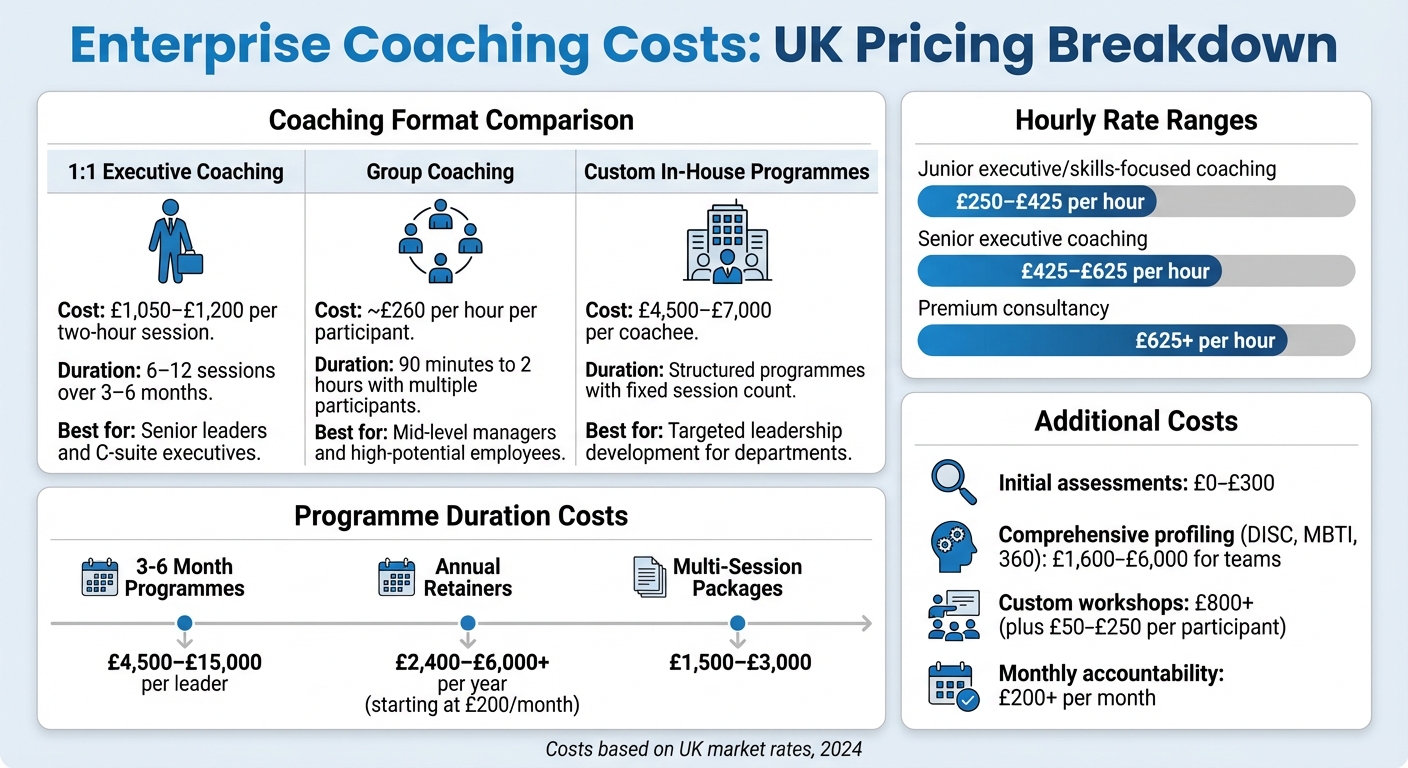
UK Enterprise Coaching Costs Comparison by Format and Programme Type
Pricing Comparison Table
Below is a concise summary of the key cost structures and formats covered earlier. Use this table to compare the pricing, structure, and suitability of different coaching formats, helping you make a more informed decision when shortlisting providers.
| Coaching Format | Cost Range | Duration/Structure | Best Use Case |
|---|---|---|---|
| 1:1 Executive Coaching | £1,050–£1,200 per two-hour session | Individual sessions, typically 6–12 sessions over 3–6 months | Senior leaders and C-suite executives needing tailored, high-level development |
| Group Coaching | ~£260 per hour per participant | Sessions of 90 minutes to 2 hours with multiple participants | Mid-level managers and high-potential employees where peer learning is beneficial |
| Custom In-House Programmes | £4,500–£7,000 per coachee | Structured programmes with a fixed session count | Targeted leadership development for specific tiers or departments |
1:1 executive coaching comes at the highest cost per session, reflecting its tailored and intensive approach. This format is ideal for senior executives or C-suite leaders where individual growth can significantly impact the organisation.
Group coaching, on the other hand, is more cost-effective per participant, with rates averaging £260 per hour. It’s a strong choice for mid-level managers or high-potential employees, especially when peer interaction and shared learning are key objectives.
Custom in-house programmes balance cost and scale, offering structured packages between £4,500 and £7,000 per coachee. These are particularly effective for developing leadership within specific tiers or departments, ensuring alignment and consistency across teams.
Tax Relief and Funding Options
UK organisations have several ways to reduce the cost of coaching programmes, including tax relief and government funding. Here’s an overview of the main options available.
Tax Deductions for Coaching
For most UK organisations, coaching costs can be claimed as a corporation tax deduction if they are exclusively for business purposes. This includes coaching aimed at improving existing skills or preparing employees for future responsibilities. Ryan Dempsey from Integro Accountants explains:
If you are paying for services that are purely for your business through improvement of your skills and/or enabling better networking, then yes, this counts as a company expense and as such can be claimed.
Employer-funded coaching is also exempt from tax and National Insurance under the "work-related training" category, as defined in Section 250 of the Income Tax (Earnings and Pensions) Act 2003. This exemption often covers additional costs like travel, subsistence, and childcare incurred during training. VAT-registered businesses may also reclaim VAT on coaching fees if they qualify as an allowable expense.
Self-employed individuals and business owners can deduct training costs if the training updates their existing skills. However, expenses related to acquiring entirely new skills or starting a business are not eligible. If coaching has both business and personal benefits, only the business-related portion can be deducted. Given the complexities of distinguishing between revenue and capital expenses, consulting an accountant is recommended.
In addition to tax relief, government schemes provide further financial support for leadership development.
Government Grants and Loans
Several government initiatives are available to help businesses manage the cost of coaching. For example:
- The Help to Grow: Management programme offers subsidised leadership training for SMEs with 5–249 employees. The programme costs around £750 and includes structured coursework and one-to-one mentoring.
- The Apprenticeship Levy allows large employers (payroll over £3 million) to fund training through levy contributions. Smaller businesses can benefit from co-investment schemes where the government covers 95% of apprenticeship training costs.
Regional initiatives add further opportunities. For instance, the Business Development Grant Scheme in Scarborough provides up to £5,000 for growth and development activities, while Enterprise Loans can offer up to £250,000 specifically for training and development. Small businesses might also explore accessing unused Apprenticeship Levy funds transferred from larger organisations to cut costs further.
Per-Employee Training Benchmarks
To plan budgets effectively, organisations can use average training spend as a benchmark. In the UK, the typical training expenditure is around £1,700 per employee. This figure helps businesses evaluate whether their coaching investment aligns with industry norms and determine how many employees can participate within their budget constraints.
Conclusion
Breaking down coaching costs helps businesses allocate budgets effectively and achieve better returns. Session fees will depend on the delivery format and the scale of the programme. Be sure to account for extras such as assessments, workshops, or accountability services to avoid any surprises.
Key Takeaways
Clear cost structures and a focused coaching strategy can deliver strong results. Success often hinges on selecting the right coaches, concentrating on key stakeholders, and taking advantage of tax relief opportunities. In the UK, research suggests high-quality executive coaching typically costs between £1,050 and £1,200 for a two-hour session, with no evidence suggesting that paying more guarantees better outcomes.
Target coaching efforts on leaders whose performance has a direct impact on your organisation’s success. When choosing a coach, look for substantial business experience - ideally over nine years for senior leadership roles - along with formal accreditation and a solid business background.
Tax relief can help reduce overall costs, as many coaching expenses qualify as legitimate business expenses in the UK. By factoring in tax relief and exploring volume discounts, businesses can optimise their investment. When paired with a thoughtful mix of delivery formats, organisations can create cost-efficient coaching programmes that deliver measurable leadership improvements.
FAQs
What factors determine the cost of enterprise coaching in the UK?
Several elements affect the pricing of enterprise coaching in the UK. These include the coach's experience and qualifications, the programme's structure and length, and the delivery method, whether it involves one-to-one sessions, group coaching, or a mix of both.
Bespoke programmes designed to address specific organisational challenges or tailored for senior leadership often carry a higher price tag. Additional features, like assessments or ongoing support, can further influence the total cost. For organisations, breaking down these factors is essential for planning and allocating budgets for coaching programmes effectively.
What are some practical ways for organisations to lower the cost of executive coaching programmes?
Organisations can take practical steps to manage and lower the cost of executive coaching programmes. Choosing package deals or long-term retainers often works out cheaper than paying by the hour, offering better value and more predictable budgeting. Similarly, opting for online or hybrid formats can cut costs tied to travel, venue hire, and catering.
Another cost-saving approach is group or team coaching, which spreads the expense across several participants, lowering the per-person cost. To avoid overspending, it’s important to align coaching programmes with clear leadership objectives and steer clear of excessive customisation when standardised options can meet the organisation’s needs effectively. By carefully assessing providers and selecting scalable solutions, organisations can meet their leadership development goals while keeping costs under control.
What are the advantages of virtual or hybrid coaching compared to in-person sessions?
Opting for virtual or hybrid coaching formats can bring notable benefits, particularly when it comes to cost efficiency and flexibility. Virtual coaching removes the need for expenses like venue hire, travel, and catering - common costs for in-person sessions. This often results in savings of 15–30%, allowing organisations to make better use of their training budgets. Virtual sessions also tend to be easier to fit around busy schedules, making them more accessible and helping to maintain participant engagement.
Hybrid coaching offers a mix of online and in-person sessions, combining cost savings with the advantages of face-to-face interaction. While it reduces expenses related to travel and physical venues, it still provides opportunities for personal connection, which can be important for building rapport. Hybrid formats are also well-suited to organisations with distributed or remote teams, offering a scalable approach to leadership development. These options present a practical and budget-friendly way to deliver effective coaching at scale.