Typical leadership training costs vary widely in the UK. View typical leadership training costs in the UK.
When budgeting for leadership training in the UK, it's important to consider costs beyond facilitator fees. In-person training often includes venue hire, travel, and catering, making it 15–30% more expensive than online options. Virtual training, while requiring higher upfront investment in technology and content development, can reduce overall costs by up to 67% for recurring programmes. Each format has distinct cost structures, affecting trainer fees, logistics, participant productivity, and programme design.
This guide breaks down the five main cost factors influencing leadership training budgets and compares in-person, online, and hybrid formats. For more information and to compare providers, visit Leadership Training Hub.
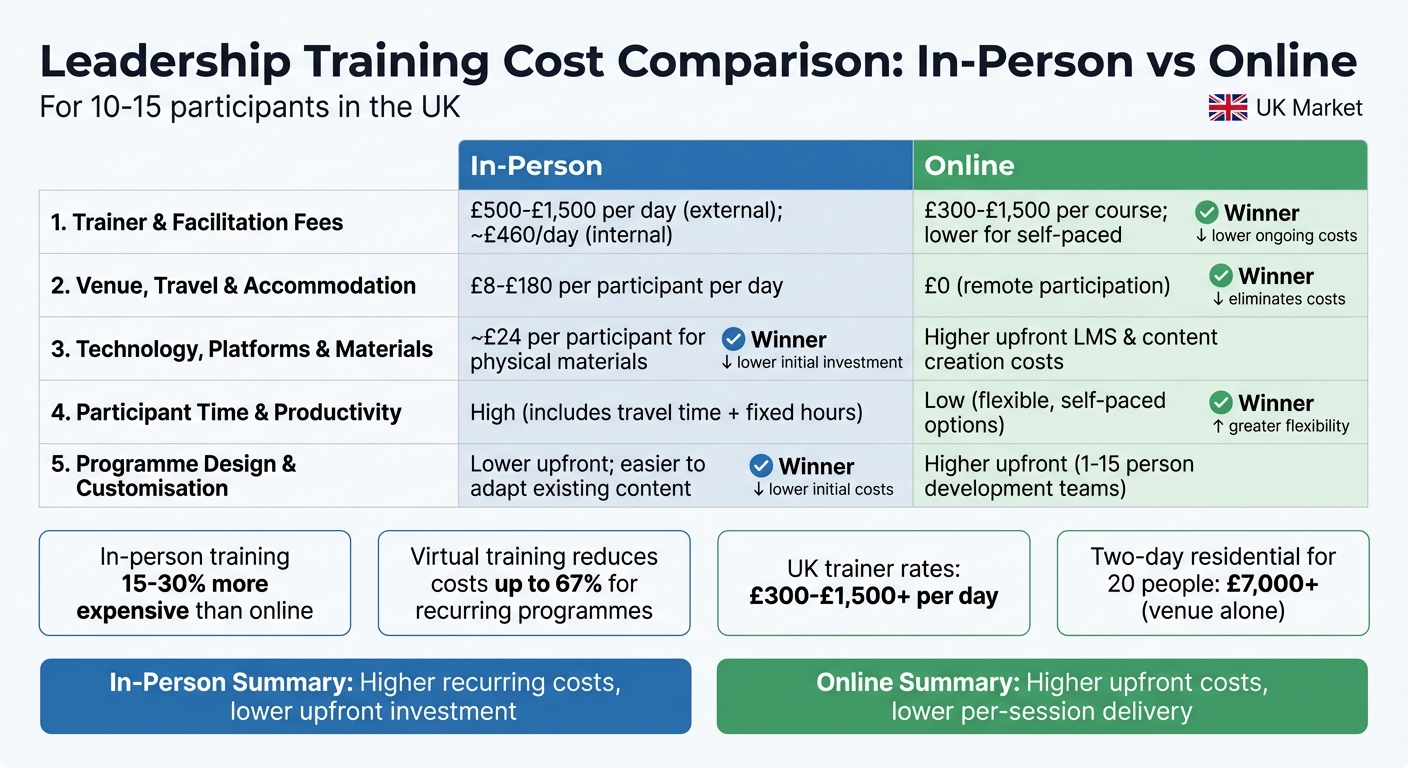
In-Person vs Online Leadership Training Cost Comparison UK
The New Model Of Live, Cohort-Based Leadership Training (Course Hero Case Study)

1. Trainer and facilitation fees
Leadership training costs in the UK vary depending on whether the programme is delivered in person or online. In-person sessions typically involve ongoing facilitator fees for live delivery, whereas online courses require higher initial development investment but become more cost-effective as participant numbers increase. This distinction highlights the need to consider other related expenses.
In the UK, trainer day rates generally range from £300 to over £1,500, depending on the trainer's expertise and experience. For example, in 2019, IT trainers charged an average of £403 per day. Sharon Gaskin, Founder of The Trainers Training Company, explains:
When a client books you as a trainer, they're not just paying for the hours you're working with them but also for the knowledge, skills and experience you bring with you.
Trainers based in London often charge higher rates, reflecting the higher living costs in the capital.
Pricing structures for training services typically fall into four categories: hourly rates, day rates, per-participant fees, or fixed project fees. Public courses often charge per participant, with fees ranging from £200 to £800 for a one-day workshop. On the other hand, corporate in-house training usually follows a per-day pricing model, costing between £2,000 and £5,000+. For larger groups, in-house training can provide better value, and costs often vary depending on the seniority of participants. Executive leadership programmes for senior management, for instance, are significantly more expensive than training designed for junior staff.
It's important to account for potential hidden costs. Day rates often include preparation time, custom programme design, material production, and post-session debriefs, though not all quotes make these elements clear. Projects with tight deadlines may also involve "rush fees" to cover non-standard working hours. Additionally, when commissioning bespoke training, it’s worth clarifying intellectual property rights, as continued use of training materials might lead to additional charges.
Online training introduces a different cost model. While in-person programmes require a facilitator for every session, online courses allow for more cost-effective scalability once the content is developed. However, some online programmes may involve extra costs for technical support alongside the instructor, which is not typically required for face-to-face workshops. Over time, the scalability of online training can lead to significant cost savings, especially for recurring programmes.
2. Venue, travel, and accommodation
In-person leadership training can bring about significant location-related expenses, costs that online vs in-person formats eliminate entirely. Venue hire is often the most noticeable expense, with hotel conference rooms typically priced between £50 and £160 per hour. Mid-range hotels usually offer daily rates of £250 to £300, though premium venues can charge upwards of £500 per hour. Additionally, organisations need to budget for A/V equipment like projectors, microphones, and high-speed Wi-Fi, which adds to overall venue costs. These expenses also contribute to the total cost of accommodation.
The choice of training delivery method also affects accommodation costs. On-site training conducted at company premises is the most cost-effective option, with basic catering costing around £8 per participant per day. Off-site non-residential training increases costs to about £75 per participant per day, covering venue hire and catering. For residential programmes that require overnight stays, the cost rises to approximately £180 per participant per day. In some scenarios, venue and accommodation expenses can make up more than 70% of the total cost.
Travel costs grow with the number of participants and how spread out they are geographically. If the venue is not centrally located, organisations may need to cover transport, parking, and daily allowances for attendees. These expenses can add up quickly. For example, a two-day residential programme for 20 participants could easily surpass £7,000 in venue and accommodation expenses alone, even before factoring in trainer fees.
Online training formats, on the other hand, eliminate venue and travel costs entirely. Participants can join sessions from their desks or homes, and facilitators avoid travel-related expenses and time. For organisations running multiple training sessions annually, especially for geographically dispersed teams or senior executives with high opportunity costs, these savings can be considerable.
3. Technology, platforms, and materials
Online leadership training often requires a notable initial outlay for technology. Organisations typically need to invest in a Learning Management System (LMS), authoring tools, and video conferencing platforms to host content, track learner progress, and deliver interactive modules. Creating digital content can also be time-consuming and resource-heavy.
In contrast, in-person training tends to rely on simpler technology, as most organisations already have basic tools like projectors or laptops. However, there are recurring costs for physical materials such as printed manuals, binders, pens, and flip-chart pads, which average around £24 per participant per day. For instance, a two-day workshop for 20 participants would cost approximately £960 in materials alone. Some programmes may also require more advanced tools, adding to the overall expense.
Specialised programmes, whether online or in-person, may demand advanced technology. For example, computer simulations designed for middle managers can cost around £13,500, including licence fees and consultant support. If high-powered computers are needed but unavailable, hiring them could add roughly £300 per day or £1,500 for a five-day course.
A key consideration here is scalability. Digital materials involve a one-time development cost and can be reused across multiple sessions, making them more cost-efficient for organisations running frequent training or catering to dispersed teams. On the other hand, physical materials incur ongoing costs with each new cohort, which can add up over time.
When assessing technology investments, it’s important to weigh the upfront costs against long-term benefits. Reviewing existing platforms can help reduce initial expenses. Additionally, organisations should factor in participants' computer literacy, as technical difficulties may require extra support to ensure the training runs smoothly.
sbb-itb-fa39ac2
4. Participant time and productivity impact
Time spent away from regular duties is an often-overlooked cost of leadership training. Organisations need to assess the work hours lost when employees attend training sessions, which can be calculated by multiplying an individual's hourly rate (including benefits) by the total training duration. For employees on higher salaries, these lost hours can lead to a considerable expense. This issue becomes more pronounced with in-person training formats due to additional time commitments.
In-person training typically requires travel, which adds several hours to the time employees spend away from work. Online training, on the other hand, eliminates the need for commuting and offers flexibility. Caroline Lawless, Senior Content Marketing Manager at LearnUpon, highlights this benefit: "Your employees can learn from their own desks, on a bus commuting to work, or during their lunch break". This flexibility not only removes travel time but also allows training to fit around day-to-day business needs.
Traditional training formats that require synchronous attendance can take entire teams out of action at the same time, disrupting decision-making and potentially slowing operations - especially in smaller organisations. Online and asynchronous learning methods, however, enable participants to engage with content during quieter periods in their schedules, minimising immediate disruptions to productivity.
Supervisors also face additional costs related to managing and following up on training, which can increase hourly expenses by 10–20%. Moreover, organisations should account for a potential dip in productivity immediately after training, as participants may need time to adapt to new skills or approaches. Blended learning models, which integrate short online modules with focused face-to-face coaching, can help balance these productivity challenges while keeping participants engaged.
5. Programme design, customisation, and follow-up
Creating a tailored leadership programme requires significant preparation. This often starts with pre-programme diagnostics, which may include analysing your industry, interviewing stakeholders, and using tools like Harrison assessments to pinpoint leadership behaviours and potential risks. For example, developing a customised six-hour workshop can take about 28 hours, covering research, design, rehearsal, and follow-up.
Costs for customised corporate training typically range from £2,000 to £5,000+ per trainer day. For a group of 15 participants, a bespoke programme might cost £10,000 to £15,000 in total, which is a more economical option compared to sending each person to a £2,000 public course, which could total £30,000.
The level of customisation heavily influences the overall cost. Using an existing framework and adapting it to your organisation’s needs is more affordable than designing a completely new programme. Sharon Gaskin from The Trainers Training Company points out that balancing budget limitations with the depth of the programme is a key consideration.
Embedding learning after the training is another crucial aspect, but it comes with added costs. Post-training support - such as follow-up materials, access to trainers for questions, action learning sets, or coaching sessions - ensures that participants apply their new skills effectively. For instance, a year-long coaching accountability system can cost between £9,500 and £22,000. Similarly, the Total Leadership programme for UK local government offers 12 months of extended support at £4,995–£5,250 + VAT.
The delivery format also affects costs. In-person programmes incur additional expenses, such as printed materials, venue hire, and trainer travel for on-site preparation. On the other hand, online and hybrid formats shift the focus to technology, including Learning Management Systems, video conferencing tools, and digital engagement platforms. Online post-training support can often be more cost-efficient, as digital tools allow for remote coaching and alumni networking without travel-related costs. However, in-person training often comes at a premium due to logistical requirements.
When budgeting, it’s important to clarify what is included in the headline fee. This could cover certification exam fees, coaching sessions, or access to digital resources. Additionally, customised training for groups of 10 or more can reduce the per-person cost, offering better value through volume discounts or long-term agreements. These factors highlight the need to align programme design with your organisation’s priorities to ensure both effectiveness and cost-efficiency.
Cost Comparison Table
Here’s a breakdown of cost ranges for in-person versus online leadership training, based on a standard programme for 10–15 participants. The table highlights key cost factors and identifies which format tends to be more expensive.
| Cost Factor | In-Person Format | Online Format | Costlier Option |
|---|---|---|---|
| Trainer & Facilitation Fees | £500–£1,500 per day for external consultants; approximately £460 per day for internal trainers | £300–£1,500 per course; lower costs for self-paced content delivery | In-Person |
| Venue, Travel & Accommodation | £8–£180 per participant per day (ranging from on-site catering to residential programmes) | £0 (participants join remotely) | In-Person |
| Technology, Platforms & Materials | Around £24 per participant for physical materials such as binders, pens, and flip charts | Higher initial costs for LMS subscriptions, content creation tools, and technical support | Online |
| Participant Time & Productivity | High (includes travel time and fixed hours away from work) | Low (flexible options, including self-paced learning) | In-Person |
| Programme Design, Customisation & Follow-up | Lower upfront design costs; existing content can be adapted more easily | Higher upfront investment; development often involves teams of 1–15 people | Online |
In-person training typically involves higher ongoing costs, such as facilitator fees, venue hire, and travel expenses. On the other hand, online training demands a larger initial investment in technology and content development but offers reduced costs for ongoing delivery. This table provides a clear overview of cost considerations, helping organisations align their training approach with their budget priorities.
Conclusion
In-person training comes with recurring expenses such as facilitator fees, venue hire, travel, and catering. On the other hand, online formats often demand a higher upfront investment in areas like design, technology, and content creation but benefit from lower costs per session delivery.
Both formats also carry hidden costs that can affect overall budgets. For example, in-person training can lead to additional expenses like travel time and reduced productivity, while online sessions may require technical support or incur extra fees for learning management systems (LMS). It's a common misconception that off-site training is more affordable than eLearning, but this isn't always the case.
UK-specific factors further shape these costs. Recent inflation and rising petrol prices have driven up the costs of face-to-face training, while many providers continue to operate under fixed funding rates.
To manage budgets effectively, organisations should account for both visible and hidden expenses across the programme's lifecycle. Key considerations include how frequently the training will be delivered, the location of participants, and whether your organisation already has the necessary technology for online sessions. For more insights and to compare providers, visit Leadership Training Hub and find options that align with your budget. You can also [compare executive coaching programs] (https://www.leadershiptraininghub.com/blog/top-5-executive-coaching-programs-cost-and-value-guide/) to see how individual development costs differ from group training.
FAQs
What unexpected costs should you consider for in-person leadership training?
In-person leadership training can bring about extra costs that organisations might not initially account for. These can include travel and accommodation expenses for participants, the loss of working time while employees are away from their usual responsibilities, and potential dips in productivity during their absence. There might also be additional charges for exam retakes or extra materials that aren’t part of the original training package.
Another factor to think about is the possible disruption to daily operations, particularly if key team members are attending the sessions. Careful planning and a well-thought-out budget can help anticipate these costs, reducing unexpected challenges and ensuring the training runs more smoothly.
What factors should organisations consider when choosing between in-person and online leadership training?
Choosing between in-person and online leadership training will depend on your organisation’s priorities, audience, and budget. In-person training typically involves higher costs, such as venue hire, catering, travel, and accommodation. On the other hand, online training often shifts these expenses to technology requirements, like learning management systems or video conferencing platforms. For geographically dispersed teams, online formats can be a more budget-friendly option by cutting out travel-related costs.
Here are some key factors to weigh up:
- Learning goals: If your programme relies heavily on interactive activities, such as role-plays or group discussions, in-person sessions may be more effective. Conversely, online formats are often better suited for knowledge-based learning or self-paced modules.
- Team location: Virtual sessions can offer much-needed flexibility for teams spread across multiple locations, particularly for organisations with remote or hybrid working arrangements.
- Cost breakdown: Assess all expenses, including venue hire, travel, trainer fees, technology licences, and any potential impact on productivity, to determine which format offers the best value for your needs.
Once you’ve clarified your requirements, the Leadership Training Hub can connect you with UK-based providers offering training in your preferred format, helping you align your programme with both your budget and development goals.
What should I budget for when choosing technology for online leadership training?
When planning your budget for technology in online leadership training, focus first on the essential tools like a learning management system (LMS) and content authoring software. Licensing fees for these tools can differ based on factors such as the number of users, storage requirements, and the level of support provided. If you already have an authoring platform, check whether you’ll need additional modules or upgrades to produce interactive and engaging content.
It’s also important to consider hosting and bandwidth expenses, especially if your programme includes video streaming or simulations. For organisations with learners spread across the UK or globally, a content delivery network (CDN) can help ensure smooth access, although this may introduce extra usage-based charges. Make sure to include GDPR-compliant hosting and robust data security measures in your budget. If your LMS needs to integrate with HR systems, factor in those integration costs as well.
Lastly, set aside funds for unexpected costs such as mobile optimisation, analytics dashboards, or scalability enhancements. Leadership Training Hub can assist you in comparing providers and pricing, helping you create a realistic technology budget that fits your organisation’s goals.