I budget for annual leadership development in the UK by adding provider fees, VAT, expenses and staff time, rather than relying on the advertised course price.
Published examples in this guide include short online courses from £239 + VAT per person and coaching retainers of £800–£2,400 per month. I compare per-person, group and monthly charges separately, then check in-person, online and hybrid options against the same brief. <u>VAT treatment matters</u>: the standard rate is 20%, but exemptions and recovery can change the final cost.
This guide sets out annual budgets for 1, 5, 10, 25 and 50 participants, with planning assumptions kept separate from supplier prices. I use the provider directory, leadership training and executive coaching categories, and cost guides to build a shortlist and request written quotes.
1. Open Leadership Programmes: Per-Person Fees
Fees and charging basis
Open programmes usually publish fees per place, making costs straightforward to budget. Total spend is the per-person fee multiplied by the number of places, plus VAT and any travel costs. For emerging managers, online or short live-online courses can be the lowest-cost option.
Revolution Learning lists its one-day Leadership Skills course at £239 + VAT online or £299 + VAT in person, while its two-day Leadership and People Management course is £399 + VAT online or £529 + VAT in person.
Senior executive programmes cost more.
A five-day strategic-leader programme is £10,950 + VAT.
Compare course length and seniority with the requirements of the role when reviewing leadership training providers in the directory.
Delivery format and inclusions
Revolution Learning’s in-person Leadership Skills fee includes lunch, refreshments and materials. Online delivery removes travel costs, but budgets should still account for staff time spent attending and completing pre-work.
For hybrid programmes, request a written breakdown of modules, campus visits and coaching sessions. Check whether the fee includes assessment, accreditation and post-course support.
Total annual budget
Multiply the per-person rate by the number of attendees, then apply any volume discount. Check group-booking terms before using the headline fee in an annual budget.
Revolution Learning lists its one-day online course at £203.15 + VAT per person for three or more delegates attending the same date. Five places therefore cost £1,015.75 before VAT, or £1,218.90 including 20% VAT, rather than £1,434 at the undiscounted rate.
Confirm current prices and discounts with shortlisted providers. Add any travel, accommodation and staff release time excluded from the fee. Where several employees need the same content, compare the total with a fixed in-house fee using the leadership training cost guide.
sbb-itb-fa39ac2
2. In-House Leadership Workshops: Fixed Fees
Fees and charging basis
In-house fees cover the whole group, not individual places.
PTP publishes one-day rates of £1,250 for 1–5 delegates and £1,690 for 6–10, excluding VAT, plus £100 per additional delegate. At 10 delegates, the effective rate is £169 per delegate, not a published per-person fee. A 15-delegate booking would cost £2,190 before VAT, or £146 per delegate.
Fixed fees suit groups that need the same content. Compare the group fee with the cost of equivalent open-course places, matching duration and scope. Avoid adding delegates just to reduce the per-person cost.
The Chartered Insurance Institute sets Managers as Coaches at 10–14 delegates, which is a practical ceiling for interactive delivery.
Delivery format and inclusions
PTP includes trainer travel and accommodation within mainland UK. Exclusions affect your annual budget, particularly for in-person and hybrid delivery.
Check whether the fee includes tailoring, materials, assessment and follow-up. For in-person workshops, confirm room hire and catering costs; for online delivery, check platform fees and technical support. Request a separate hybrid quote covering room equipment and remote support.
Total annual budget
Budget by cohort, not headcount alone.
Three cohorts for 25 employees - 10, 10 and 5 - cost £4,630 before VAT using PTP’s published bands. At 20% VAT, the cash requirement is £5,556, before excluded extras; check VAT recovery.
When comparing providers in the leadership training directory, request a written annual quote covering cohort limits, repeat-delivery discounts, preparation fees and postponement terms. For senior-team or bespoke workshops, ask providers to separate design costs from delivery fees so you can budget for later sessions.
For a longer, multi-module programme, compare cohort pathways.
3. Cohort Leadership Pathways: Programme Fees
Fees and charging basis
Cohort pathways combine several sessions and support in one programme fee. Providers charge per place in an open cohort or a fixed fee for a private cohort.
Nine Dots lists £1,440 plus VAT per open-cohort place and £7,200 plus VAT for a private cohort of 8–12 managers. At 10 participants, that works out at £720 plus VAT each before any extras.
Compare the total cohort fee, minimum participant numbers and included support, rather than the headline price per person. Check that the programme suits the participants’ seniority, from first-line management skills to executive strategy.
Delivery format and inclusions
Compare programme duration and support, not just classroom days.
Cambridge Judge lists both a six-week online format and a 9–12 month blended option.
Ask for an itemised breakdown covering programme fees, coaching, assessments, certification, peer groups and follow-up support.
RCN’s Developing Leadership Programme lists £5,958 including VAT for an online cohort of 15 and £6,966 including VAT for an in-person cohort of 15, a difference of £1,008 before organisation-specific travel or venue costs.
For hybrid pathways, confirm the schedule and any technology charges. Do not budget for them as online-only programmes.
Total annual budget
A 10-manager private cohort with Nine Dots costs £8,640 including VAT, before extras and any recoverable VAT.
If a pathway spans financial years, confirm payment dates and budget separately for staff time. Use the leadership training directory to shortlist providers by seniority and delivery format, then check cohort capacity and included support.
4. Executive Coaching: Monthly Retainers
Fees and charging basis
Published UK coaching retainers range from £800–£2,400 per participant per month, usually covering two sessions and between-session access. These are indicative market prices, not a fixed tariff. For directors and executives, compare coaches’ senior-level experience, session length and between-session support - not just whether they work with similar job titles.
Delivery format and inclusions
Coaching fees depend more on engagement terms than venue type. Online delivery removes travel and venue costs, but retainers often remain similar. In-person or hybrid coaching may suit sensitive transitions or board-level work.
Check whether the fee includes materials, email, messaging, ad hoc calls, 360 feedback, psychometrics, stakeholder interviews and end-of-engagement reviews. Get between-session access terms in writing, including contact channels, response times and limits on extra calls. Confirm cancellation terms, unused-session rollover and confidentiality boundaries, particularly what the coach can report to the board or sponsor.
Total annual budget
Calculate the total retainer spend before comparing coaching with programme fees. Budget for contracted months, not an assumed 12-month term. These examples show costs within a year for different contract lengths, not fixed fees by seniority.
Planning scenario Calculation Fee before VAT and extras Director, six months £1,000 × 6 £6,000 Executive, nine months £1,500 × 9 £13,500 Board-level participant, six months £2,200 × 6 £13,200
Add unrecoverable VAT, assessments and expenses. Multiply the retainer by the number of participants, keeping organisation-wide design and stakeholder-work charges separate. When comparing provider listings, record the contracted months, scheduled sessions and total expected cost alongside the monthly fee.
The next section compares how in-person, online and hybrid delivery affects costs across all leadership development models.
In-Person, Online and Hybrid Delivery: Costs and Trade-Offs
Compare pricing, learning hours and support - not just the delivery format. Your annual budget needs to cover provider fees, participant numbers and any extra costs.
| Format | Buying model and provider fees | Travel and venue costs | Scale and interaction | Best fit and budget risks |
|---|---|---|---|---|
| Asynchronous online | Per-person licence or subscription; some programmes have a published course fee | No delegate travel or physical venue needed | Suits large groups, but live feedback is limited without tutor-led elements | Basic knowledge and pre-work for aspiring or first-line managers. Flexible scheduling, but low completion rates can waste budget. |
| Live virtual | Per-delegate open-course fee or fixed private-session or cohort fee | No delegate travel or room hire | Reaches dispersed teams; discussion and role-play need groups small enough for participation | Emerging and middle managers who need practice and feedback. Check technology, accessibility and facilitator capacity. |
| In-person | Per-delegate fee, in-house day rate or venue package | Rail fares or mileage, accommodation, catering and room costs may apply | Room size limits capacity; allows direct observation and informal networking | Senior-team alignment, sensitive discussions and simulations. Travel and venue costs add to the total. |
| Hybrid | Bespoke programme fee, usually quotation-only | Travel and venue costs still apply to classroom elements | Delivers core content to larger groups while retaining facilitated practice | Longer programmes for high-potential staff or senior leaders. Design, coordination, platforms and coaching may carry separate charges. |
The same leadership topic can require very different annual budgets depending on delivery format and headcount. Online courses also vary in length, tutor input and assessment.
For lower-cost self-study, Virtual College lists its eight-course, CPD-certified Leadership and Management Training Package at £90 + VAT per person for approximately 7–8 hours. By contrast, University of Essex lists its 13-week, 20-credit Leadership and Management Development course at £1,468 for UK learners in 2026–27, including teaching materials and required reading.
For facilitated training, virtual delivery may cost less than classroom delivery, but this is not always the case.
PTP advertises its two-day Excellence in Leadership programme from £650 virtually and £980 in the classroom - a £330 gap before travel and venue costs. Salford lists its CMI Level 5 Certificate at £2,350 + VAT through either virtual or face-to-face delivery.
Compare qualification level, assessment and tutor input alongside format. Use the same participant numbers, learning hours, inclusions, VAT basis and travel or venue costs when checking options across the provider directory, leadership training category and cost and pricing pages.
For hybrid quotations, ask for separate prices for digital content, live sessions, classroom days, diagnostics and coordination. These cost headings also apply to the annual budget examples below.
Annual Budget Examples for 1, 5, 10, 25 and 50 Participants
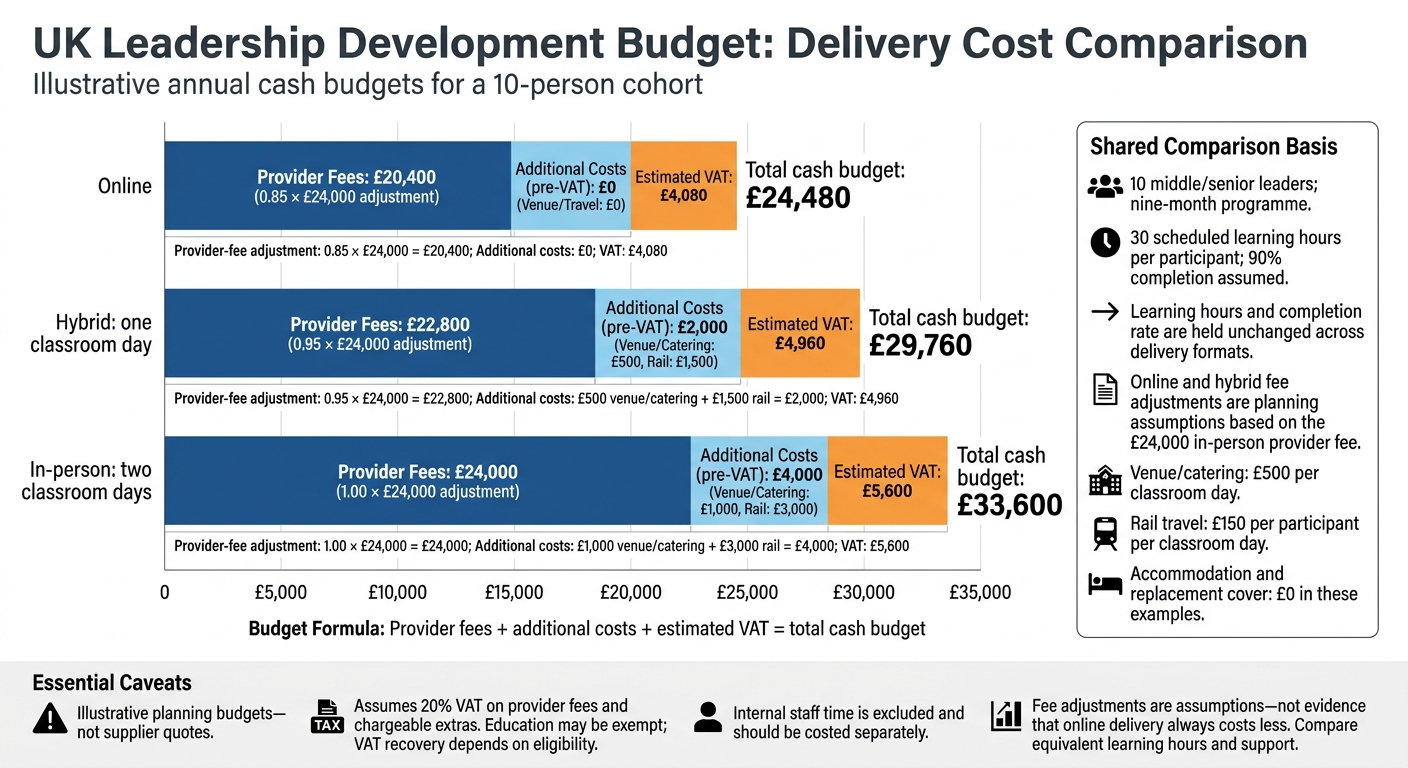
UK Leadership Development Budget: Delivery Cost Comparison
These examples turn the earlier pricing models into annual cash budgets by group size. Use them when comparing leadership training providers and executive coaching providers, alongside the directory’s cost and pricing pages.
These are illustrative planning budgets, not supplier quotes. For personalized estimates, use an executive coaching cost calculator. Cash per person is based on enrolled headcount. Completion rates are budgeting assumptions, not predicted results.
| Participants and model | Format, duration and learning hours | Rate and charging basis | Fees before VAT | Additional costs before VAT | Estimated VAT | Total cash budget | Cash per person | Cash per completed learning hour |
|---|---|---|---|---|---|---|---|---|
| 1 executive: coaching retainer | Online; six months; 6 × 2-hour sessions; 100% completion | £1,200 monthly retainer × 6 months | £7,200 | £500 assessment and evaluation | £1,540 | £9,240 | £9,240 | £770.00 |
| 5 managers: open programme | In-person; six months; 2 × 6-hour days; 90% completion | £2,000 per person × 5 | £10,000 | £1,500 rail travel | £2,300 | £13,800 | £2,760 | £255.56 |
| 10 middle/senior leaders: private cohort | In-person; nine months; 2 classroom days plus virtual sessions; 30 hours each; 90% completion | £24,000 fixed cohort fee | £24,000 | £1,000 venue/catering + £3,000 rail travel | £5,600 | £33,600 | £3,360 | £124.44 |
| 25 managers: cohort pathway | Hybrid; 12 months; 2 classroom days plus online learning; 24 hours each; 80% completion | £8,000 fixed fee + £1,000 per participant | £33,000 | £1,000 venue/catering + £1,000 evaluation | £7,000 | £42,000 | £1,680 | £87.50 |
| 50 aspiring/first-line managers: blended programme | Hybrid; 12 months; 2 classroom days plus digital learning; 20 hours each; 80% completion | £450 licence × 50 + £5,000 implementation and evaluation | £27,500 | £1,000 venue/catering | £5,700 | £34,200 | £684 | £42.75 |
Cash per completed learning hour = total cash budget ÷ (participants × scheduled hours × completion rate).
Fee assumptions: Fees include materials, standard assessments, admin, platform access and evaluation unless stated otherwise. Coaching includes preparation, between-session contact and progress reviews; the extra £500 covers assessment and evaluation. Check cancellation and qualification-registration charges before approving the budget.
Expense assumptions: Where not included, venue and catering cost £500 per classroom day. Rail travel is budgeted at £150 per participant per classroom day for the five- and ten-person groups. The five-person programme includes venue costs; the ten-person cohort allows for two classroom days. There is no travel allowance for the 25- and 50-person groups. The 25-person pathway includes £1,000 for external evaluation. Accommodation and replacement cover are set at £0; where overnight stays are needed, add an illustrative £180 per stay.
VAT and internal time: These budgets assume 20% VAT on provider fees and chargeable extras. Education may be exempt, and VAT recovery depends on eligibility. Internal staff time is excluded and should be costed separately.
The table below shows how delivery format changes the ten-person cohort’s total cash budget, keeping learning hours and completion rate unchanged. Fee adjustments are assumptions based on the £24,000 in-person fee - not evidence that online delivery always costs less.
| Delivery | Provider-fee adjustment | Additional costs before VAT | Estimated VAT | Total cash budget |
|---|---|---|---|---|
| Online | 0.85 × £24,000 = £20,400 | £0 venue, travel or accommodation | £4,080 | £24,480 |
| Hybrid: one classroom day | 0.95 × £24,000 = £22,800 | £500 venue/catering + £1,500 rail | £4,960 | £29,760 |
| In-person: two classroom days | 1.00 × £24,000 = £24,000 | £1,000 venue/catering + £3,000 rail | £5,600 | £33,600 |
Shortlist Providers Within Your Annual Budget
Use your annual budget ceiling to shortlist providers by audience seniority, delivery format and published price. Compare leadership training and executive coaching options to find a programme model that fits your audience and the support they need.
Only include listings with a published price or a written quotation status. Treat “from” prices as starting points, not approved budgets, and request written confirmation of scope. Record verified details in one row per provider, linking to its directory listing.
| Provider/listing link | Programme model | Seniority | Format | Price status | VAT inclusion | Charging model | Minimum group size | Session length | Programme length | Travel and venue costs | Included support | Annual total |
|---|---|---|---|---|---|---|---|---|---|---|---|---|
| Verified provider listing URL | Open programme | Confirm audience fit | Confirm delivery | Published price, “from” price or quote only | Confirm | Per delegate | Confirm | Record teaching hours | Record dates | Record exclusions | Record included support | Delegates × fee + extras + VAT due |
| Verified provider listing URL | Workshop or cohort pathway | Confirm audience fit | Confirm delivery | Published price, “from” price or quote only; request a scoped group quote | Confirm | Per day, cohort or mixed | Confirm minimum size and capacity limits | Record teaching hours | Record days or months | Record exclusions | Separate included and optional support | Fixed fees + participant charges + extras + VAT due |
| Verified provider listing URL | Coaching retainer | Confirm leadership level | Confirm delivery | Published price, “from” price or quote only | Confirm | Per person per month | Confirm | Record contact hours | Record contracted months | Record exclusions | Confirm between-session access | People × monthly fee × contracted months + extras + VAT due |
Use a consistent VAT basis when calculating cost per participant: annual total ÷ enrolled participants. Calculate cost per completed learning hour as annual total ÷ (expected completers × formal learning hours per person).
Before approval, confirm scope, inclusions, accessibility, cancellation terms and quote expiry. For coaching, also confirm confidentiality. Compare annual totals, cost per participant and cost per completed learning hour only after matching learning hours and support.
FAQs
How should I split my budget between new managers and senior leaders?
Match your leadership development budget to participants’ seniority and development goals. As a guide, allocate 60–70% to group training that can serve larger numbers of first-line managers, 20–30% to blended learning programmes for mid-level managers, and 10–15% to tailored executive coaching for senior leaders.
These are flexible ranges, not fixed requirements. For teams of five or more, prioritise in-house group training providers. Reserve one-to-one executive coaching for senior transitions or complex, confidential challenges.
How do I cost staff time for leadership development?
Include participants’ salaries for time spent in training as a direct cost. Account for indirect costs too, including reduced productivity during training and any replacement cover needed.
Calculate the total investment by adding these internal labour costs to external expenses: facilitator fees, venue hire, materials, travel and any irrecoverable VAT.
How can I measure the return on my leadership development budget?
Before training starts, use 360-degree feedback or a skills gap analysis to set a performance baseline. Agree measurable SMART goals and clear success criteria.
During and after the programme, track productivity, profit margins, employee engagement and staff turnover. Record changes in workplace behaviour and leaders’ confidence too. Compare the results with the total investment: provider fees, travel, materials and internal costs, including lost productivity.